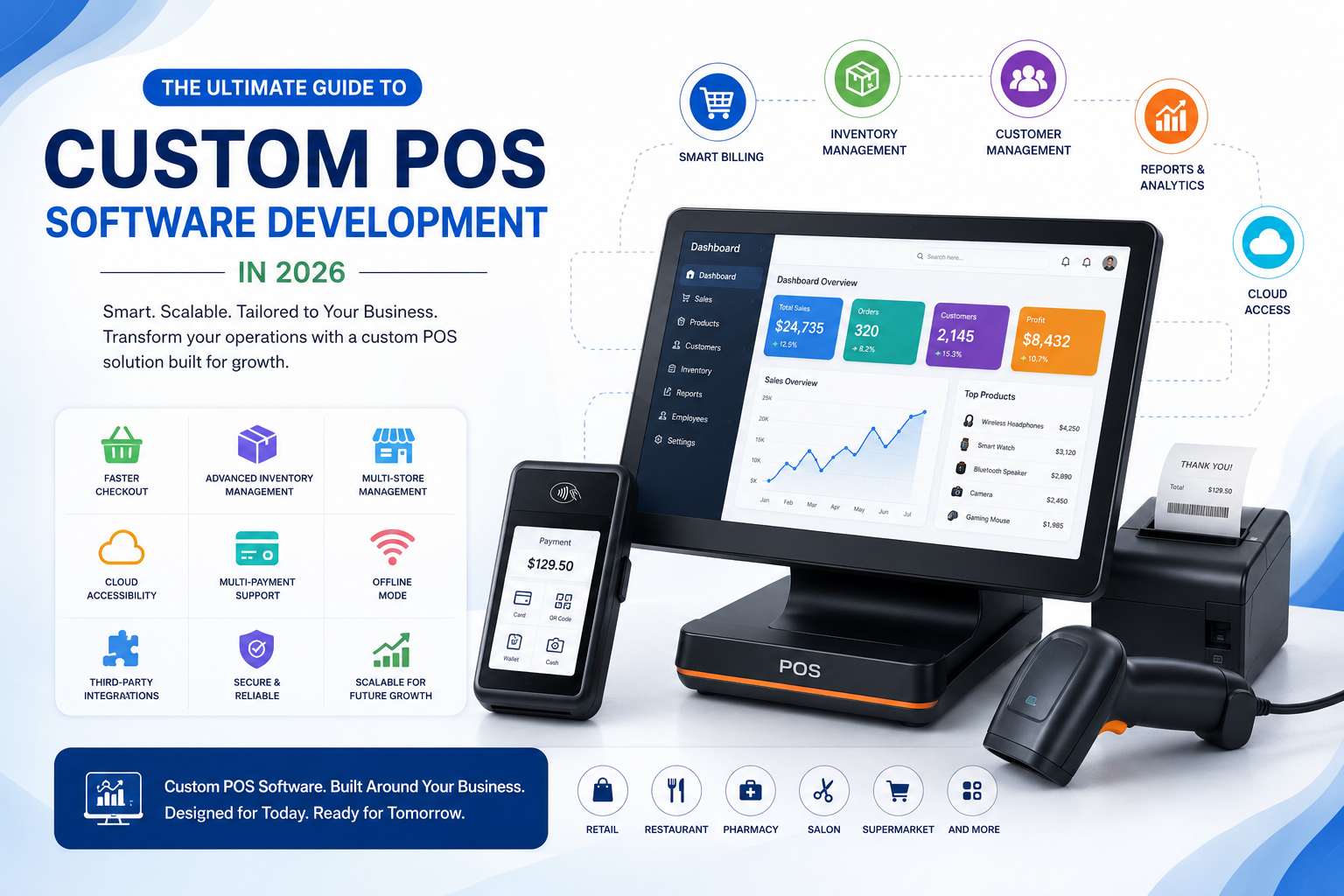
Businesses today need much more than a billing machine. Whether you own a retail store, restaurant, supermarket, pharmacy, salon, or enterprise chain, your Point of Sale (POS) system has become the central hub for managing operations.
Unfortunately, many off-the-shelf POS solutions force businesses to adjust their workflows around software limitations.
That’s why organizations worldwide are investing in Custom POS Software Development—a solution designed specifically for their business operations instead of forcing them into a one-size-fits-all system. Businesses are increasingly prioritizing flexible checkout experiences, unified operations, cloud connectivity, and workflow customization over generic feature lists.
In this comprehensive guide, we’ll explore everything you need to know about custom POS software.
What is Custom POS Software?
Custom POS (Point of Sale) software is a tailor-made solution developed according to a company’s unique business processes.
Instead of purchasing generic software with unnecessary features—or lacking the ones you actually need—a custom POS system is designed around your:
- Business workflow
- Industry requirements
- Inventory model
- Customer journey
- Payment preferences
- Reporting structure
- Future expansion plans
Unlike traditional POS systems, custom software grows alongside your business.
Why Businesses Are Moving Toward Custom POS Solutions
Modern businesses operate differently.
A clothing store has different requirements than a restaurant.
A pharmacy needs completely different workflows than a supermarket.
A salon manages appointments, while a warehouse focuses on inventory movement.
Generic software often creates unnecessary complexity.
Custom POS eliminates these limitations by providing:
- Faster checkout
- Better inventory management
- Business-specific automation
- Personalized reporting
- Scalable architecture
- Better customer experiences
This shift reflects a broader industry trend toward configurable workflows rather than rigid POS templates.
Key Benefits of Custom POS Software Development
1. Built Around Your Business
Every business follows different operational processes.
Custom software allows every screen, workflow, button, report, and automation to match your business perfectly.
No compromises.
2. Faster Billing Process
An optimized POS system reduces billing time significantly.
Features include:
- Barcode scanning
- Quick product lookup
- Touchscreen interface
- One-click checkout
- Multiple payment methods
This improves customer satisfaction while reducing queues.
3. Advanced Inventory Management
Inventory becomes effortless with features like:
- Live stock tracking
- Multi-warehouse support
- Batch management
- Low-stock alerts
- Purchase order generation
- Supplier management
Businesses always know what’s available.
4. Multi-Store Management
For growing businesses, managing multiple locations becomes simple.
Centralized dashboards provide:
- Sales reports
- Inventory synchronization
- Employee performance
- Customer data
- Branch comparisons
Everything updates in real time.
5. Cloud Accessibility
Modern cloud POS systems allow owners to access business information from anywhere.
Whether you’re traveling or working remotely, you can monitor:
- Sales
- Inventory
- Staff activity
- Daily reports
- Customer insights
Cloud-native architectures are becoming a standard expectation for modern POS deployments.
Essential Features of a Modern Custom POS System
Smart Billing
- Fast checkout
- GST/VAT support
- Split payments
- Discounts
- Refunds
- Returns
- Gift cards
Inventory Management
- Barcode support
- Stock alerts
- Product variants
- Batch tracking
- Purchase management
- Supplier management
CRM Integration
Understand your customers better through:
- Purchase history
- Loyalty rewards
- Personalized offers
- Birthday discounts
- Customer segmentation
Employee Management
Track:
- Attendance
- Shift timings
- Sales performance
- Commission
- Role-based access
- Permissions
Reports & Analytics
Generate reports like:
- Daily Sales
- Profit Margin
- Best Selling Products
- Slow Moving Inventory
- Tax Reports
- Employee Reports
- Customer Reports
Multi-Payment Support
Accept:
- Credit Cards
- Debit Cards
- Mobile Wallets
- QR Payments
- Contactless Payments
- Cash
- Gift Cards
Offline Mode
Business should never stop because of internet issues.
A custom POS can continue processing sales offline and automatically sync data once the connection is restored.
Third-Party Integrations
Custom POS software can integrate with:
- ERP
- CRM
- Accounting Software
- E-commerce Platforms
- Payment Gateways
- Shipping Providers
- Marketing Tools
Industries That Need Custom POS Solutions
Custom POS software works across multiple industries, including:
- Retail Stores
- Grocery Stores
- Restaurants
- Cafés
- Hotels
- Pharmacies
- Medical Stores
- Salons
- Spas
- Electronics Stores
- Jewelry Shops
- Fashion Retailers
- Supermarkets
- Wholesale Businesses
- Warehouses
- Automobile Stores
Each industry benefits from tailored workflows and reporting.
Custom POS vs Off-the-Shelf POS
| Feature | Custom POS | Off-the-Shelf POS |
|---|---|---|
| Customization | Unlimited | Limited |
| Scalability | Excellent | Moderate |
| Ownership | Full | Vendor Controlled |
| Integrations | Unlimited | Limited |
| Business Workflow | Personalized | Generic |
| Security | Higher | Shared Standards |
| Future Expansion | Easy | Restricted |
Technologies Used in Custom POS Development
Modern POS software is built using technologies such as:
Frontend
- React
- Angular
- Flutter
- Electron
Backend
- Node.js
- Laravel
- ASP.NET
- Java
- Python
Database
- PostgreSQL
- MySQL
- MongoDB
Cloud
- AWS
- Microsoft Azure
- Google Cloud
Payment Integration
- Stripe
- Square
- PayPal
- Authorize.Net
Development Process
A successful POS development project generally follows these stages:
Step 1
Business Analysis
Step 2
Requirement Gathering
Step 3
UI/UX Design
Step 4
Software Architecture
Step 5
Development
Step 6
Testing
Step 7
Deployment
Step 8
Training
Step 9
Maintenance & Support
Future Trends in Custom POS Software
POS technology continues to evolve with:
- AI-powered sales forecasting
- Predictive inventory management
- Voice-enabled checkout
- Self-service kiosks
- Contactless payments
- Mobile POS
- Cloud synchronization
- IoT integration
- Real-time analytics
- Personalized customer experiences
Industry experts also highlight modular extensions, AI analytics, and mobile-first experiences as major priorities for next-generation POS platforms.
How Much Does Custom POS Software Development Cost?
Development costs depend on:
- Number of features
- Industry requirements
- Mobile applications
- Cloud infrastructure
- Hardware integrations
- Third-party APIs
- Security requirements
- Number of users
- Multi-location support
A basic solution costs far less than an enterprise-grade, multi-location POS platform. Costs can range from tens of thousands of dollars for smaller projects to several hundred thousand dollars for large enterprise implementations, depending on scope and complexity.
Why Choose QuartusTech for Custom POS Development?
At QuartusTech, we specialize in building scalable, secure, and industry-specific POS solutions that help businesses streamline operations and enhance customer experiences.
Our Custom POS Development services include:
- Retail POS Software
- Restaurant POS Solutions
- Cloud-Based POS Systems
- Mobile POS Applications
- Multi-Store POS Platforms
- Inventory Management Systems
- CRM & ERP Integration
- Payment Gateway Integration
- AI-Powered Analytics
- Ongoing Maintenance & Support
We focus on delivering solutions that align with your business goals while remaining flexible enough to grow with your organization.
Final Thoughts
A custom POS system is more than a billing application—it is the digital backbone of your business. From accelerating checkout and improving inventory visibility to integrating with your existing software ecosystem, a tailored POS solution gives you greater control, efficiency, and scalability than generic alternatives.
If you’re planning to modernize your operations or build a POS platform from the ground up, investing in Custom POS Software Development can provide long-term value and a competitive edge.
FAQs
What is a Custom POS System?
A Custom POS System is a tailor-made point-of-sale solution developed specifically for a business’s workflows, operational requirements, and growth plans.
Is Custom POS better than ready-made POS software?
Yes. Custom POS offers greater flexibility, scalability, ownership, and integration capabilities than most off-the-shelf solutions.
Which businesses should invest in Custom POS Software?
Retail stores, restaurants, supermarkets, pharmacies, salons, hospitality businesses, healthcare providers, and multi-location enterprises can all benefit from a custom POS.
Can a Custom POS work offline?
Yes. Most modern custom POS systems support offline billing and automatically synchronize data when internet connectivity is restored.
How long does it take to build a Custom POS?
The timeline depends on project complexity, features, integrations, and testing. Simple systems may take a few months, while enterprise solutions can require significantly longer development cycles.
Comments