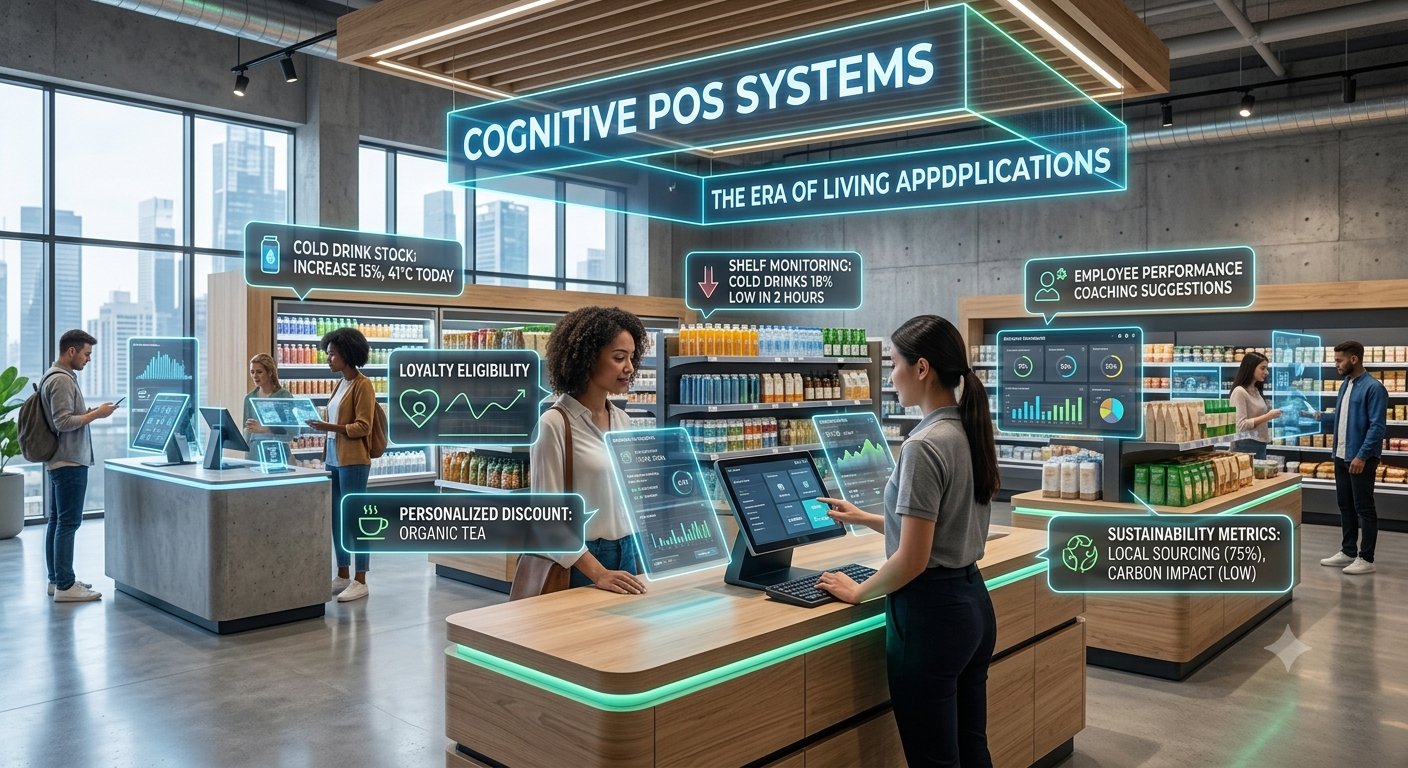
For decades, Point-of-Sale (POS) systems have been designed to answer one simple question:
“What did the customer buy?”
But tomorrow’s retailers won’t survive by only knowing the past.
The next generation of businesses needs systems capable of answering far more valuable questions:
- What will this customer buy next?
- Which employee may need assistance today?
- Which shelf will become empty in two hours?
- Which promotion will generate maximum profit?
- Which product should never be discounted?
- Which customer is about to stop visiting your store?
The future belongs to Cognitive POS Systems—software that doesn’t just process transactions but actively helps businesses make better decisions every minute.
This isn’t science fiction anymore.
It’s the next evolution of retail technology.
What Is a Cognitive POS?
A Cognitive POS is an intelligent retail platform that continuously learns from every interaction happening inside a business.
Unlike traditional POS software that records transactions, Cognitive POS systems analyze thousands of signals simultaneously:
- Sales trends
- Customer behavior
- Weather
- Local events
- Employee performance
- Inventory movement
- Seasonal demand
- Supplier delays
- Market prices
- Customer loyalty patterns
Instead of showing reports at the end of the day…
It makes recommendations while business is happening.
From Checkout Machine to Retail Brain
Imagine walking into your store.
Before opening, your POS has already prepared today’s action plan.
It tells you:
“Increase cold drink stock by 15%. Temperature will reach 41°C today.”
Another alert appears.
“Your highest-value customer hasn’t visited for 18 days. Send a personalized coupon.”
Another one:
“Cashier #2 usually experiences slower checkout speed between 4 PM and 6 PM.”
Another recommendation:
“Move Product A near the entrance. Customers purchasing it frequently buy Product B.”
Instead of reacting…
The business begins operating proactively.
Predictive Checkout Experience
Today’s checkout is reactive.
Customers arrive.
Cashier scans products.
Payment is completed.
Receipt is printed.
End of process.
A Cognitive POS transforms checkout into an intelligent experience.
Before the cashier scans products, the system already predicts:
- Preferred payment method
- Loyalty eligibility
- Personalized discounts
- Membership renewal
- Product recommendations
- Upselling opportunities
- Fraud probability
The checkout becomes conversational rather than transactional.
Every Receipt Becomes Business Intelligence
Traditional receipts end with:
“Thank You. Visit Again.”
Future receipts become personalized engagement tools.
Examples include:
- Nutrition score for grocery purchases
- Carbon footprint summary
- Loyalty progress
- Personalized savings report
- Suggested complementary products
- Health recommendations
- Subscription reminders
- Cashback opportunities
The receipt evolves into a customer relationship platform.
Inventory That Orders Itself
Retailers often struggle with two expensive problems:
- Overstock
- Stockouts
Both reduce profitability.
Future POS systems continuously monitor:
- Sales velocity
- Supplier delivery history
- Local festivals
- Weather forecasts
- Social media trends
- Online demand
- Regional purchasing patterns
Instead of waiting for manual purchase orders…
The POS automatically recommends—or even initiates—replenishment before inventory reaches critical levels.
Employee Intelligence Inside the POS
Modern POS software measures sales.
Cognitive POS measures performance.
Not just revenue.
It evaluates:
- Checkout speed
- Customer satisfaction
- Upselling success
- Error frequency
- Refund patterns
- Shift productivity
- Attendance consistency
- Peak-hour efficiency
Managers receive coaching suggestions instead of just performance reports.
Fraud Detection Before It Happens
Retail fraud continues to evolve.
Future POS systems won’t simply record suspicious activities.
They’ll predict them.
Using AI models, the system identifies unusual patterns like:
- Repeated refunds
- Inventory mismatches
- Unusual discounts
- Fake loyalty redemptions
- Cash drawer inconsistencies
- Employee behavior anomalies
Instead of investigating after losses occur…
Businesses receive real-time alerts.
The Rise of Emotion-Aware Retail
Imagine a checkout camera (with proper customer consent and privacy compliance) capable of detecting:
- Customer frustration
- Long waiting queues
- Satisfaction levels
- Confusion
- Emotional engagement
The POS can automatically:
- Open another checkout counter
- Offer instant discounts
- Notify staff
- Speed up service
Retail becomes emotionally responsive.
Hyper-Personalized Pricing
Static pricing is disappearing.
Future POS platforms may support dynamic pricing strategies based on factors such as:
- Inventory levels
- Demand patterns
- Customer loyalty
- Time of day
- Weather conditions
- Seasonal trends
- Competitor pricing
This doesn’t mean unfair pricing—it means smarter, data-driven promotions that benefit both businesses and customers.
Digital Twins of Retail Stores
One emerging concept is the Digital Twin—a virtual replica of a physical store that mirrors real-time operations.
Connected with a Cognitive POS, retailers can simulate:
- New shelf layouts
- Promotional campaigns
- Staffing plans
- Product placements
- Inventory changes
Before making changes in the real store, businesses can test them virtually and predict outcomes with greater confidence.
Voice-Driven Store Management
Imagine saying:
“Show today’s best-selling products.”
Or:
“Which cashier processed the most transactions today?”
Or:
“Forecast weekend sales.”
Instead of clicking through multiple dashboards, managers simply ask.
The POS responds instantly using natural language.
Sustainability Built Into Every Sale
Consumers increasingly value environmentally responsible businesses.
Future POS systems can automatically calculate:
- Packaging waste
- Carbon impact
- Sustainable product choices
- Local sourcing percentages
- Energy-efficient product recommendations
Retail analytics will extend beyond profit to include sustainability metrics.
AI That Learns Your Business
Every retail business is unique.
A bakery, pharmacy, electronics store, and restaurant operate differently.
A Cognitive POS continuously adapts to each business by learning:
- Peak operating hours
- Customer buying habits
- Seasonal fluctuations
- Staff performance trends
- Inventory cycles
- Local purchasing behavior
Over time, the software becomes increasingly aligned with the specific needs of that business.
Why Businesses Should Prepare Today
Retail technology is evolving rapidly, but successful adoption isn’t just about implementing AI.
It’s about building a strong digital foundation.
Businesses that begin modernizing their POS infrastructure today will be better positioned to integrate advanced capabilities such as predictive analytics, automation, and intelligent customer engagement as these technologies mature.
Waiting until competitors have already embraced these tools could mean losing valuable market share.
Comments