Introduction
For many businesses, a Point of Sale (POS) system is more than just a billing tool—it’s the heart of daily operations. From processing payments and managing inventory to tracking sales and customer data, a modern POS system plays a critical role in business success.
Yet many businesses continue to rely on generic, off-the-shelf POS software that wasn’t built for their unique workflows. While these solutions may appear affordable initially, hidden limitations often lead to higher operational costs, inefficiencies, and missed growth opportunities.
In 2026, forward-thinking businesses are investing in custom POS software designed specifically for their operations. Instead of forcing their business to adapt to software, they’re choosing software that adapts to their business.
Let’s explore why custom POS solutions consistently deliver a better return on investment.
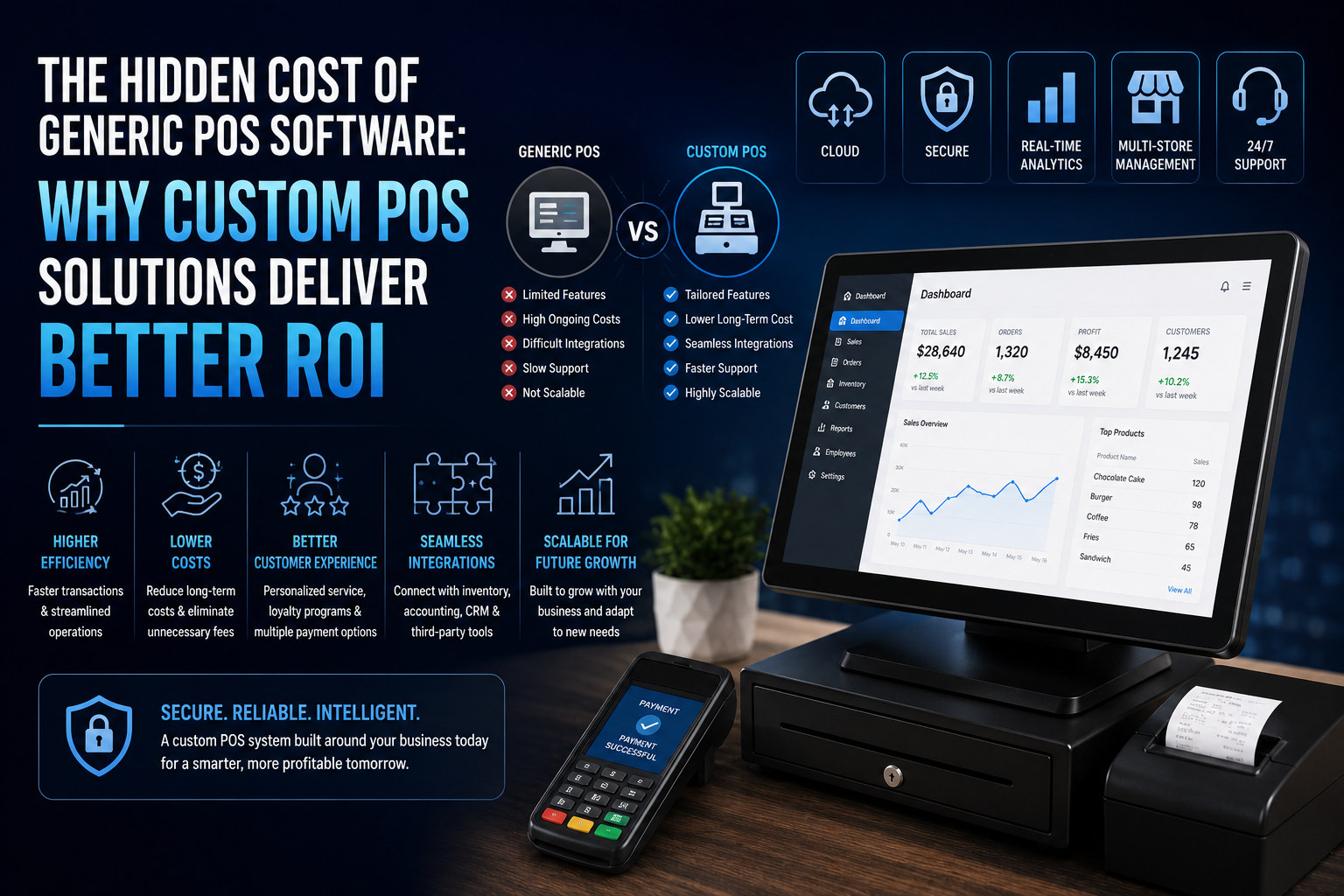
The Problem with Generic POS Software
Most ready-made POS systems are designed to serve thousands of businesses using the same feature set.
While this sounds convenient, it often creates challenges such as:
- Features you never use
- Missing functionality you actually need
- Monthly subscription fees
- Limited integrations
- Vendor lock-in
- Slow support
- Restricted customization
- Scalability issues
As your business grows, these limitations become more expensive.
What Is a Custom POS System?
A custom POS solution is built specifically around your business model.
Instead of removing your unique workflows, the software enhances them.
A custom system can include:
- Sales management
- Inventory tracking
- Customer loyalty programs
- Employee management
- Online ordering
- Kitchen Display Systems (KDS)
- Multi-store management
- Real-time analytics
- Mobile POS
- Cloud synchronization
- Third-party integrations
Everything is designed to work together.
Five Ways Custom POS Software Improves ROI
1. Faster Operations
Employees spend less time navigating unnecessary menus and more time serving customers.
Simple workflows reduce transaction times and improve customer satisfaction.
2. Lower Long-Term Costs
Although custom development requires an initial investment, businesses often save money by eliminating recurring subscription fees, expensive add-ons, and multiple third-party tools.
Over time, ownership delivers greater value.
3. Better Customer Experience
Modern customers expect:
- Faster checkout
- Multiple payment options
- Digital receipts
- Loyalty rewards
- Personalized offers
- Contactless payments
A custom POS allows you to create experiences that reflect your brand rather than the limitations of generic software.
4. Seamless Integrations
Your POS should communicate with every important business system.
Examples include:
- Accounting software
- ERP platforms
- CRM systems
- Inventory management
- Delivery platforms
- E-commerce stores
- Payment gateways
- Marketing automation tools
Integrated systems eliminate duplicate work and reduce errors.
5. Scalability
Business growth shouldn’t require replacing your entire POS system.
Custom POS software grows with you by supporting:
- Multiple locations
- Franchise management
- International currencies
- Multiple tax structures
- New payment methods
- Additional business modules
Your software evolves as your business evolves.
Industries That Benefit Most
Custom POS solutions are ideal for businesses that require specialized workflows.
These include:
Restaurants
- Table management
- Kitchen Display Systems
- Online ordering
- Split bills
- QR menu ordering
- Delivery integration
Retail Stores
- Barcode management
- Inventory automation
- Promotions
- Gift cards
- Customer loyalty
- Multi-store inventory
Grocery Stores
- Weight-based pricing
- Expiry tracking
- Supplier management
- Bulk inventory
Salons & Spas
- Appointment scheduling
- Membership plans
- Staff commissions
- Customer history
Healthcare Clinics
- Patient billing
- Appointment management
- Secure payment processing
- Insurance workflows
The Role of AI in Modern POS Systems
Artificial Intelligence is transforming POS software.
AI-powered POS solutions can:
- Forecast inventory demand
- Recommend products
- Detect suspicious transactions
- Predict peak business hours
- Automate pricing strategies
- Generate sales insights
- Improve customer retention
Businesses gain valuable insights without manual analysis.
Security Matters More Than Ever
Handling customer payments requires strong security.
A modern custom POS should include:
- PCI-compliant architecture
- Role-based access
- Data encryption
- Secure cloud backups
- Multi-factor authentication
- Fraud detection
- Audit logs
Security builds customer trust while protecting your business.
Signs You’ve Outgrown Your Current POS
You may need a custom POS solution if:
- Employees use spreadsheets alongside your POS.
- You rely on multiple disconnected systems.
- Manual data entry consumes valuable time.
- Reporting is slow or inaccurate.
- Integrations are limited.
- Monthly subscription costs continue to increase.
- Your software cannot support new business models.
These are indicators that your technology is limiting your growth.
Why Businesses Choose CustomPOS
At CustomPOS, we design intelligent POS solutions tailored to your operations—not the other way around.
Our expertise includes:
- Restaurant POS Development
- Retail POS Solutions
- Cloud POS Systems
- Mobile POS Applications
- Self-Service Kiosks
- Payment Gateway Integration
- Inventory Management
- Loyalty Programs
- Multi-Store POS
- AI-Powered POS Analytics
Every solution is built for speed, security, scalability, and long-term business success.
Conclusion
Choosing a POS system is a strategic business decision.
While generic software may seem convenient, it often introduces hidden costs that reduce productivity and limit growth.
A custom POS solution gives businesses the flexibility to streamline operations, deliver exceptional customer experiences, integrate with existing systems, and scale confidently.
If you’re ready to move beyond one-size-fits-all software, CustomPOS can help you build a solution designed specifically for your business.
Invest in a POS system that grows with your business—not one that holds it back.
Comments