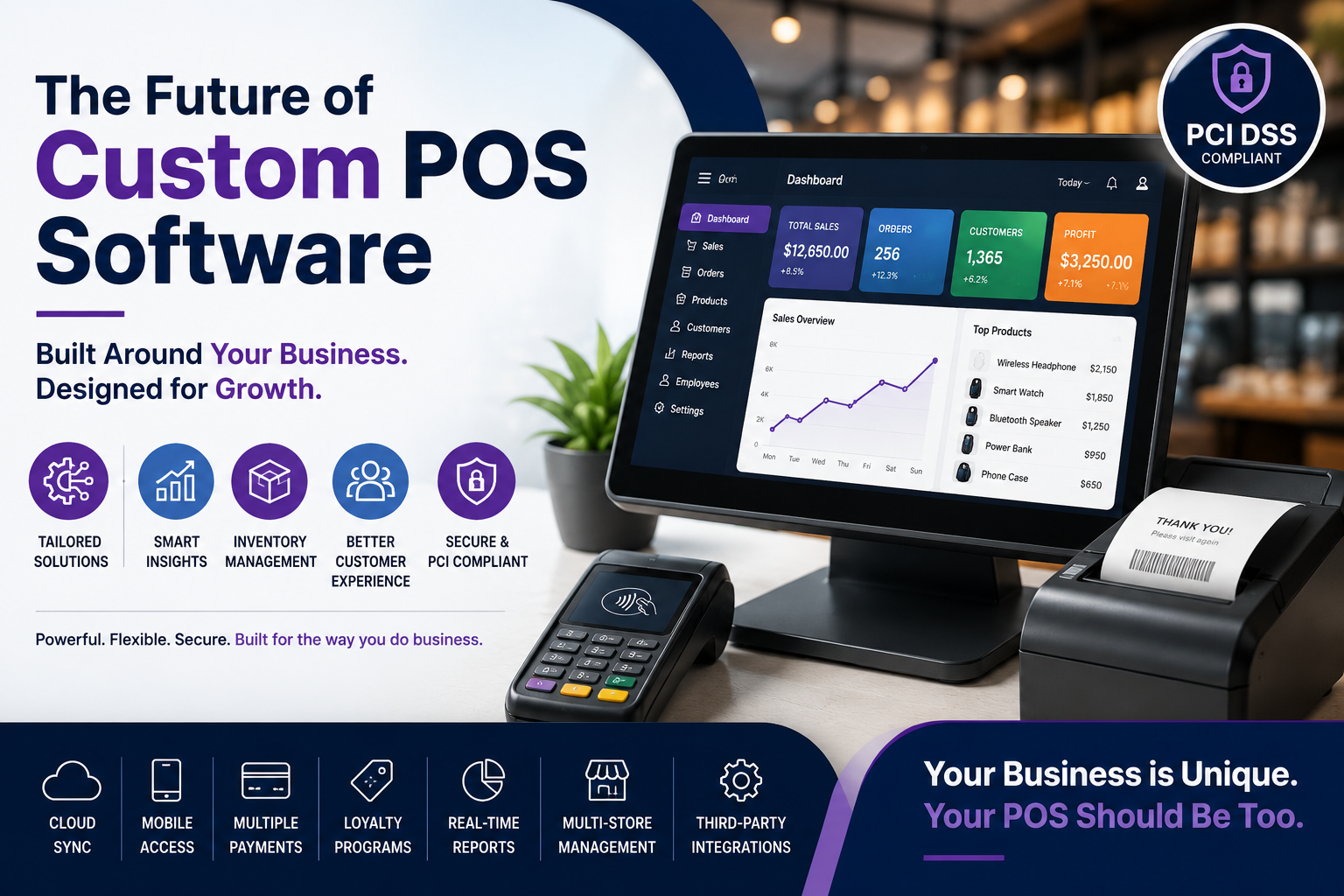
Point of Sale (POS) systems have evolved far beyond simple cash registers. Today’s businesses require intelligent, connected, and scalable solutions that streamline operations, improve customer experiences, and provide actionable business insights. While off-the-shelf POS software may meet basic needs, it often falls short as businesses grow and require specialized workflows.
In 2026, organizations across retail, restaurants, healthcare, hospitality, and service industries are increasingly investing in custom POS software to gain flexibility, efficiency, and a competitive advantage.
At Custom POS Developers, we specialize in building secure, scalable, and feature-rich POS solutions tailored to your unique business requirements.
What Is Custom POS Software?
Custom POS software is a personalized point-of-sale solution designed specifically for a business’s operations rather than using generic software with limited customization.
A custom POS system can integrate with:
- Inventory management
- Customer Relationship Management (CRM)
- Accounting software
- Payment gateways
- Loyalty programs
- Mobile applications
- E-commerce platforms
- ERP systems
Because every business operates differently, custom development ensures the software matches your workflow instead of forcing your team to adapt to generic processes.
Why Businesses Are Choosing Custom POS Solutions
1. Tailored Business Workflows
Every business has unique processes.
Custom POS software allows organizations to automate:
- Order management
- Billing workflows
- Inventory updates
- Employee scheduling
- Customer loyalty
- Discount rules
- Multi-location operations
This improves productivity while reducing manual work.
2. Better Customer Experience
Modern customers expect:
- Faster checkout
- Multiple payment options
- Digital receipts
- Personalized offers
- Loyalty rewards
- Contactless payments
Custom POS software enables businesses to deliver these experiences seamlessly.
3. Real-Time Inventory Management
Inventory inaccuracies can result in lost sales and excess stock.
Custom POS systems provide:
- Live inventory tracking
- Low-stock alerts
- Barcode scanning
- Purchase order automation
- Supplier management
- Warehouse synchronization
This ensures businesses maintain optimal inventory levels.
4. Advanced Business Analytics
Data-driven decision-making is essential in today’s competitive market.
Custom POS dashboards provide insights into:
- Daily sales
- Best-selling products
- Customer purchasing trends
- Employee performance
- Peak business hours
- Revenue by location
- Profit margins
These insights help business owners make informed decisions.
5. Scalability for Growth
As businesses expand, their software should grow with them.
Custom POS systems support:
- Multiple branches
- Franchise management
- Multi-currency support
- Multi-language interfaces
- Cloud synchronization
- API integrations
Businesses avoid costly software replacements as they scale.
Essential Features of a Modern Custom POS System
An enterprise-grade POS solution should include:
- Secure payment processing
- Barcode and QR code scanning
- Customer loyalty programs
- Gift card management
- Mobile POS
- Offline mode
- Cloud synchronization
- Employee management
- Role-based permissions
- Inventory control
- Sales reporting
- Tax management
- Digital receipts
- CRM integration
- Accounting integration
- E-commerce synchronization
Industries That Benefit from Custom POS Software
Retail
Retail businesses use custom POS systems for:
- Inventory management
- Omnichannel sales
- Customer loyalty
- Promotions
- Multi-store management
Restaurants
Restaurants benefit from:
- Table management
- Kitchen display systems
- Online ordering
- Delivery integrations
- Menu customization
- Split billing
- Tip management
Hospitality
Hotels and resorts integrate POS with:
- Room billing
- Restaurant services
- Spa bookings
- Event management
- Guest loyalty
Healthcare
Healthcare providers use POS solutions for:
- Pharmacy billing
- Patient payments
- Inventory management
- Insurance integrations
Salons & Spas
Beauty businesses automate:
- Appointment scheduling
- Membership plans
- Product sales
- Customer history
- Employee commissions
Cloud-Based vs Traditional POS
Cloud POS offers several advantages:
- Remote access
- Automatic updates
- Lower maintenance costs
- Real-time synchronization
- Secure cloud backups
- Faster deployment
Many businesses are migrating from legacy POS systems to cloud-native platforms for greater flexibility and reliability.
AI Is Transforming POS Software
Artificial Intelligence is making POS systems smarter than ever.
Modern AI-powered POS platforms can:
- Forecast inventory demand
- Recommend products
- Detect fraud
- Predict customer behavior
- Automate marketing campaigns
- Optimize pricing
- Analyze purchasing trends
AI helps businesses improve efficiency while increasing profitability.
Security in Custom POS Development
Payment security remains a top priority.
A secure POS solution should include:
- PCI DSS compliance
- End-to-end encryption
- Tokenization
- Multi-factor authentication
- Secure APIs
- User access controls
- Audit logs
- Regular security updates
Protecting customer payment data builds trust and reduces business risk.
Why Choose Custom POS Developers?
At Custom POS Developers, we build intelligent, scalable, and secure POS solutions tailored to your business needs.
Our expertise includes:
- Custom POS Software Development
- Cloud POS Solutions
- Restaurant POS Development
- Retail POS Systems
- Mobile POS Applications
- Payment Gateway Integration
- Inventory Management Systems
- Loyalty Program Development
- POS API Integrations
- PCI-Compliant Payment Solutions
We deliver future-ready POS platforms that help businesses streamline operations, improve customer experiences, and accelerate growth.
The Future of POS Technology
The next generation of POS systems will combine:
- Artificial Intelligence
- Machine Learning
- Contactless Payments
- Biometric Authentication
- IoT Devices
- Voice Commerce
- Blockchain Security
- Predictive Analytics
- Omnichannel Commerce
Businesses adopting these technologies today will be better positioned to compete in the rapidly evolving digital marketplace.
Conclusion
Generic POS software may work for small businesses with simple requirements, but growing organizations need solutions that adapt to their operations, integrate with existing systems, and support future expansion.
Custom POS software provides the flexibility, security, and intelligence required to deliver exceptional customer experiences while improving operational efficiency.
If your business is ready to move beyond the limitations of off-the-shelf software, investing in a custom POS solution is a strategic decision that can drive long-term success.
Ready to build a custom POS solution tailored to your business? Partner with Custom POS Developers to create secure, scalable, and feature-rich POS software designed for the future.
FAQs
Q1. What is custom POS software?
Custom POS software is a tailored point-of-sale solution built to match a business’s specific workflows, payment processes, and operational requirements.
Q2. Which industries benefit from custom POS development?
Retail, restaurants, healthcare, hospitality, pharmacies, salons, and service businesses all benefit from customized POS systems.
Q3. Is a custom POS system scalable?
Yes. Custom POS solutions can easily support multiple locations, cloud deployment, third-party integrations, and future business growth.
Q4. Why is PCI DSS compliance important for POS systems?
PCI DSS compliance helps protect payment card data, reduces the risk of breaches, and ensures secure payment processing.
Comments