A restaurant doesn’t operate like a retail store. A pharmacy doesn’t manage inventory like a supermarket. A salon has completely different customer workflows than a convenience store.
Yet thousands of businesses still rely on generic Point of Sale (POS) systems that force them to change their operations instead of supporting them.
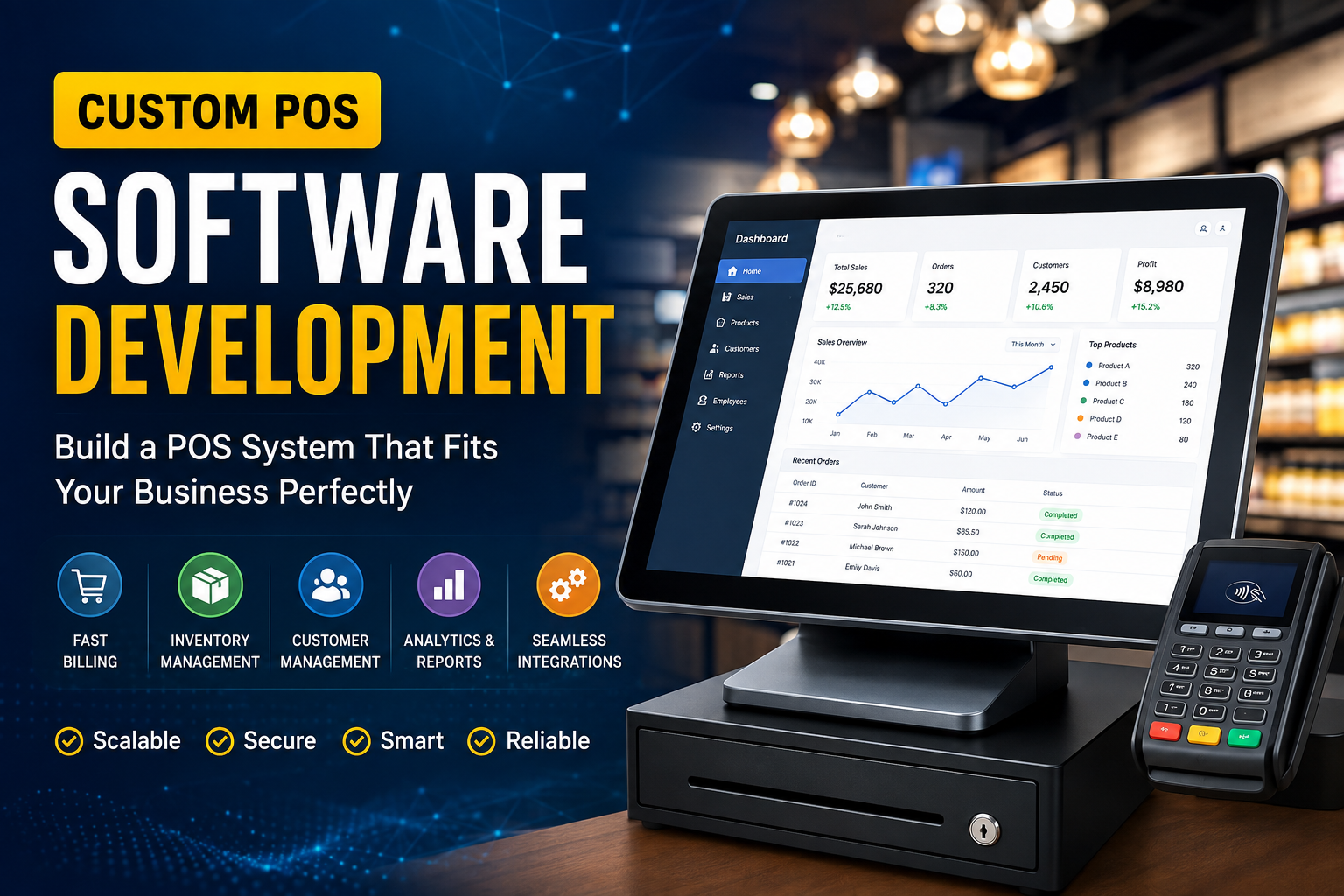
That is exactly why Custom POS Software Development has become one of the fastest-growing technology investments in 2026. Businesses increasingly want software built around their own processes, integrations, and customer experience rather than adapting to limitations imposed by off-the-shelf solutions.
What is Custom POS Software?
Custom POS software is a tailor-made Point of Sale solution developed specifically for a business’s operations.
Instead of paying monthly for features you never use—or missing features you desperately need—a custom POS gives you complete control over:
- Billing
- Inventory
- Customer Management
- Employee Management
- Analytics
- Payments
- Integrations
- Business Rules
Your software works exactly how your business works.
Why Generic POS Systems Eventually Become a Problem
Many businesses begin with ready-made POS software because it’s quick and inexpensive.
But as the business grows, limitations appear:
- Limited customization
- Monthly subscription costs
- Vendor lock-in
- Poor third-party integrations
- Limited reporting
- Slow support
- Restricted workflows
- Hardware compatibility issues
Eventually, businesses spend more time working around the software than actually using it.
That’s when custom development becomes the smarter long-term investment.
Industries That Benefit from Custom POS Development
Custom POS solutions are ideal for:
Retail Stores
- Multi-location inventory
- Barcode scanning
- Loyalty programs
- Promotions
- Gift cards
Restaurants
- Kitchen Display Systems (KDS)
- Table management
- Online ordering
- Split billing
- QR ordering
Pharmacies
- Medicine inventory
- Expiry tracking
- Prescription management
- GST billing
Grocery Stores
- Fast checkout
- Weight-based pricing
- Bulk inventory
- Supplier management
Salons & Spas
- Appointment booking
- Staff scheduling
- Memberships
- Product sales
Healthcare Clinics
- Patient billing
- Inventory
- Digital records
- Insurance integrations
Must-Have Features in a Modern Custom POS
1. Fast Billing
Customers expect quick checkout.
Your POS should support:
- Barcode scanning
- QR scanning
- Touch interface
- Multiple payment methods
- Digital receipts
2. Inventory Management
Inventory should update automatically after every sale.
Features include:
- Real-time stock updates
- Low-stock alerts
- Purchase orders
- Supplier tracking
- Batch management
3. CRM & Loyalty Programs
A modern POS should help you retain customers.
Features include:
- Customer profiles
- Reward points
- Coupons
- Membership discounts
- Purchase history
4. Multi-Store Management
For growing businesses:
- Centralized dashboard
- Branch management
- Shared inventory
- Employee access controls
- Consolidated reports
5. AI-Powered Analytics
Modern POS systems are becoming smarter with AI.
Capabilities include:
- Sales forecasting
- Product recommendations
- Demand prediction
- Customer segmentation
- Automated reports
AI-driven features are becoming increasingly common as retailers modernize their operations.
Cloud POS vs Traditional POS
| Feature | Traditional POS | Custom Cloud POS |
|---|---|---|
| Remote Access | ❌ | ✅ |
| Automatic Updates | ❌ | ✅ |
| Real-time Reports | Limited | ✅ |
| Multi-store Support | Limited | ✅ |
| Data Backup | Manual | Automatic |
| Scalability | Low | High |
Cloud-based custom POS solutions provide flexibility for businesses operating across multiple locations.
Essential Integrations
A modern POS should connect seamlessly with:
- Accounting Software
- ERP Systems
- CRM Platforms
- Payment Gateways
- E-commerce Stores
- Delivery Apps
- Warehouse Systems
- Marketing Platforms
- SMS & Email Services
- BI Dashboards
Security & Compliance
Security is critical for handling payment data and customer information.
A secure custom POS should include:
- PCI DSS compliance
- Role-based access control
- Encrypted payment processing
- Secure cloud backups
- Audit logs
- Two-factor authentication
- Data encryption
- Automatic updates
Offline Mode Matters
Internet outages happen.
A well-designed custom POS should:
- Continue billing offline
- Store transactions securely
- Sync automatically when the connection returns
- Prevent duplicate records
Offline capability is considered a key requirement for reliable POS deployments, especially in high-volume environments.
Benefits of Custom POS Software
Improved Efficiency
Automates repetitive tasks and reduces manual work.
Faster Checkout
Shorter queues improve customer satisfaction.
Better Reporting
Make decisions using real-time business insights.
Lower Long-Term Costs
Avoid recurring licensing fees and pay only for features your business needs.
Business Scalability
Expand locations, users, and services without replacing your POS.
Complete Ownership
You own the software, source code, and data.
Emerging Trends in Custom POS Development
Businesses are increasingly adopting:
- AI-powered sales insights
- Voice-assisted checkout
- Self-service kiosks
- Mobile POS
- Contactless payments
- QR ordering
- Cloud synchronization
- Predictive inventory management
- Omnichannel commerce
- Customer personalization
How Custom POS Developers Can Help
An experienced development partner can deliver:
- Requirement analysis
- UI/UX design
- POS architecture
- Web & mobile development
- Hardware integration
- Payment gateway integration
- API development
- Cloud deployment
- Security implementation
- Ongoing maintenance
Why Choose Custom POS Over Ready-Made Software?
Generic software is built for everyone.
Custom software is built for your business.
With a tailored POS, you gain:
- Higher productivity
- Better customer experience
- Greater flexibility
- Seamless integrations
- Improved scalability
- Stronger security
- Long-term cost savings
As businesses continue to digitize operations, investing in a custom POS system is no longer just a technology upgrade—it’s a strategic advantage that helps improve efficiency, customer satisfaction, and future growth.
Frequently Asked Questions
What is a Custom POS System?
A custom POS system is a point-of-sale solution designed specifically for a business’s workflows, industry requirements, and operational goals.
Is custom POS software worth the investment?
Yes. For businesses with unique workflows, multiple locations, or specialized integration needs, a custom POS often provides better long-term value than generic subscription-based software.
Can a custom POS work without internet?
Yes. Modern custom POS systems can operate offline and automatically synchronize transactions once connectivity is restored.
Which industries benefit most from custom POS software?
Retail, restaurants, pharmacies, supermarkets, salons, hospitality, healthcare, and franchise businesses commonly benefit from tailored POS solutions.
How long does custom POS development take?
The timeline depends on project complexity, integrations, and testing. Basic systems may take a few months, while enterprise-grade platforms require more extensive development and validation.
Comments