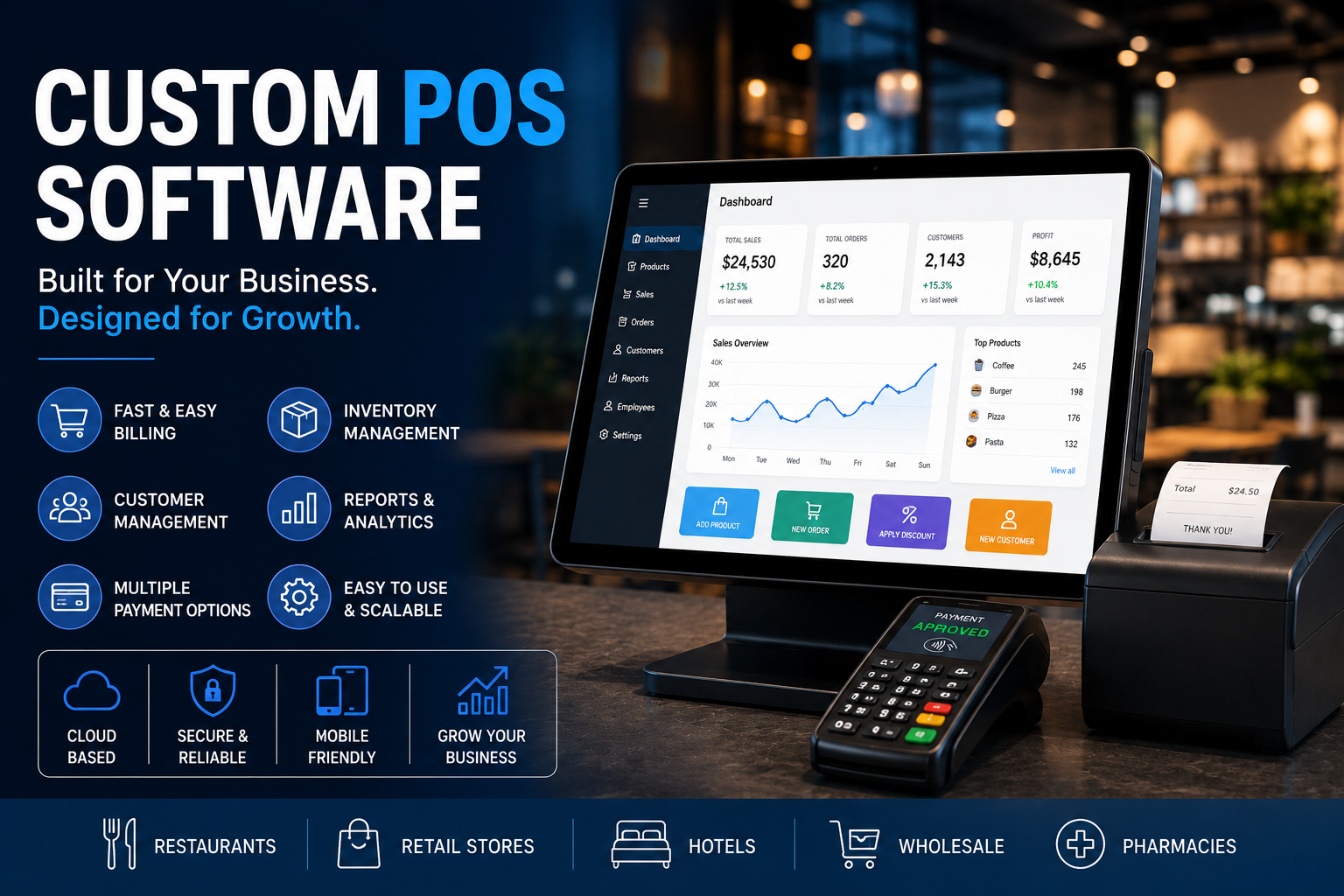
The point-of-sale (POS) system has evolved far beyond a traditional cash register. In 2026, businesses are looking for POS solutions that can manage transactions while also supporting inventory, customer relationships, analytics, employee management, online ordering, and integrations with other business platforms.
While ready-made POS platforms can work for many businesses, companies with unique workflows often need something more flexible. This is where custom POS software development can provide a significant advantage.
What Is Custom POS Software?
Custom POS software is a point-of-sale solution designed and developed specifically around a business’s operational requirements.
Instead of changing business processes to fit a standard POS product, a custom POS system can be built around existing workflows.
A custom POS solution can include:
- Billing and payment processing
- Inventory management
- Product management
- Customer management
- Employee management
- Sales reporting
- Multi-location management
- Online ordering
- Loyalty programs
- Accounting integrations
- CRM integrations
- Third-party APIs
This flexibility makes custom POS development particularly valuable for growing businesses and companies with specialized requirements.
Why Businesses Are Choosing Custom POS Development in 2026
Modern businesses need more than basic transaction processing. They need real-time information and connected systems that help them make better decisions.
Custom POS software can help businesses achieve this by combining operational tools into a single platform.
1. Customized Business Workflows
Every business operates differently.
A restaurant may need table management and kitchen integration, while a retail company may require barcode scanning, inventory transfers, and purchase-order management.
Custom POS software allows these workflows to be incorporated directly into the system.
2. Better Integration
Businesses often use multiple applications for different functions.
A custom POS system can integrate with:
- Payment gateways
- Accounting software
- CRM platforms
- E-commerce platforms
- Inventory systems
- Delivery platforms
- Loyalty programs
- Business analytics tools
This reduces the need for employees to manually transfer information between systems.
3. Improved Scalability
A standard POS system may work well initially but become restrictive as a business expands.
Custom POS software can be designed to support:
- Multiple stores
- Multiple warehouses
- Multiple currencies
- Multiple user roles
- Regional operations
- Franchise management
The system can evolve alongside the business.
Essential Features of Custom POS Software
Inventory Management
Inventory management is one of the most important features of modern POS software.
Businesses can use a custom POS system to track:
- Stock levels
- Product variations
- Purchases
- Sales
- Transfers
- Low-stock alerts
- Supplier information
Real-time inventory data can help businesses reduce stock shortages and improve purchasing decisions.
Payment Processing
A modern POS system should support secure and convenient payment options.
Depending on the business and market, these may include:
- Credit and debit cards
- Contactless payments
- Digital wallets
- QR-based payments
- Online payments
- Integrated payment terminals
Payment processing should be implemented with appropriate security and compliance considerations.
Customer Management
Custom POS software can store customer information and transaction history to help businesses deliver more personalized experiences.
Features may include:
- Customer profiles
- Purchase history
- Loyalty points
- Discounts
- Customer segmentation
- Personalized offers
Employee Management
Businesses can also use POS software to manage employees and user permissions.
Useful capabilities include:
- Staff accounts
- Role-based permissions
- Shift management
- Attendance integration
- Sales performance
- Activity tracking
Analytics and Reporting
Data-driven decision-making is becoming increasingly important.
A custom POS dashboard can provide real-time insights into:
- Daily sales
- Best-selling products
- Revenue trends
- Inventory levels
- Employee performance
- Customer behavior
- Store performance
Businesses can use this information to identify opportunities and improve operational efficiency.
Custom POS for Different Industries
Restaurant POS
Restaurants often require specialized POS functionality such as:
- Table management
- Kitchen order management
- Menu management
- Split billing
- Online ordering
- Delivery integration
- QR ordering
- Kitchen display systems
A custom restaurant POS can be designed around the restaurant’s exact service workflow.
Retail POS
Retail businesses may require:
- Barcode scanning
- Product variants
- Inventory management
- Purchase orders
- Customer loyalty
- Returns and exchanges
- Multi-store management
Hospitality POS
Hotels and hospitality businesses can integrate POS systems with reservations, room services, restaurants, and accounting systems.
Wholesale and Distribution
Wholesale businesses can benefit from custom features such as:
- Bulk pricing
- Customer-specific pricing
- Purchase management
- Warehouse management
- Sales representatives
- Credit management
Cloud-Based Custom POS Software
Cloud technology has transformed modern POS systems.
A cloud-based POS solution allows authorized users to access business information across multiple locations.
Potential benefits include:
- Centralized data
- Real-time reporting
- Easier updates
- Remote management
- Multi-location visibility
- Automated backups
- Scalable infrastructure
For businesses operating multiple locations, centralized cloud management can provide significant operational advantages.
Mobile POS Systems
Mobile POS is another important trend in 2026.
Businesses can use tablets and smartphones as POS devices, providing greater flexibility for:
- Restaurants
- Retail stores
- Events
- Pop-up shops
- Field sales
- Hospitality businesses
Mobile POS can reduce hardware dependency and enable employees to process transactions closer to customers.
AI and Custom POS Software
Artificial intelligence is creating new opportunities for POS platforms.
AI-powered POS systems can analyze business data and help identify:
- Sales trends
- Customer preferences
- Inventory patterns
- Potential stock shortages
- Product opportunities
- Unusual transaction activity
For example, a restaurant could analyze historical sales data to forecast demand for specific menu items.
AI can therefore transform a POS system from a transaction-processing tool into a business intelligence platform.
Security in Custom POS Development
Security is critical because POS systems handle valuable business and payment information.
A secure POS solution should consider:
- Data encryption
- Secure authentication
- Role-based access
- API security
- Payment security
- Regular security testing
- Secure cloud infrastructure
- Backup and recovery procedures
Businesses should also consider applicable industry compliance requirements when designing their POS architecture.
Custom POS vs. Ready-Made POS
The choice between custom and ready-made POS software depends on business requirements.
A ready-made POS may be suitable when a company needs standard features and wants to deploy quickly.
Custom POS development may be more appropriate when a business requires:
- Unique workflows
- Specialized integrations
- Industry-specific functionality
- Multi-location customization
- Advanced reporting
- Greater control over the product roadmap
The biggest advantage of custom development is flexibility.
How Custom POS Development Works
A typical custom POS development process includes:
Step 1: Requirement Analysis
The development team understands the business model, workflows, users, integrations, and required features.
Step 2: UI/UX Design
The POS interface is designed to make daily operations fast and intuitive.
Step 3: Architecture Planning
Developers define the database, APIs, cloud infrastructure, security model, and application architecture.
Step 4: Development
The POS system is developed according to the approved requirements.
Step 5: Integration
Payment gateways, accounting platforms, inventory systems, CRM platforms, and other services can be integrated.
Step 6: Testing
The application is tested for functionality, performance, security, compatibility, and usability.
Step 7: Deployment
The completed POS solution is deployed to the required devices and infrastructure.
Step 8: Maintenance
Continuous monitoring, updates, security improvements, and feature enhancements help keep the platform reliable.
The Future of Custom POS Software
POS systems are increasingly becoming central business platforms rather than simple billing tools.
Future POS solutions are likely to focus on:
- AI-powered analytics
- Automated inventory forecasting
- Omnichannel commerce
- Mobile-first experiences
- Contactless payments
- Cloud-based operations
- Real-time business intelligence
- Automated customer engagement
Businesses that invest in flexible POS technology can build a stronger foundation for future digital transformation.
Conclusion
Custom POS software gives businesses the flexibility to build a point-of-sale system around their specific operational requirements. From payment processing and inventory management to customer analytics, employee management, cloud integration, and AI-powered insights, a modern POS platform can support much more than transactions.
For growing businesses, restaurants, retailers, wholesalers, and multi-location companies, custom POS development can provide the scalability and flexibility needed to compete in an increasingly digital market.
Suggested SEO Keywords: custom POS software, custom POS development, custom point of sale software, POS software development, custom restaurant POS, retail POS development, cloud POS software, mobile POS development, POS system development, custom billing software
Comments