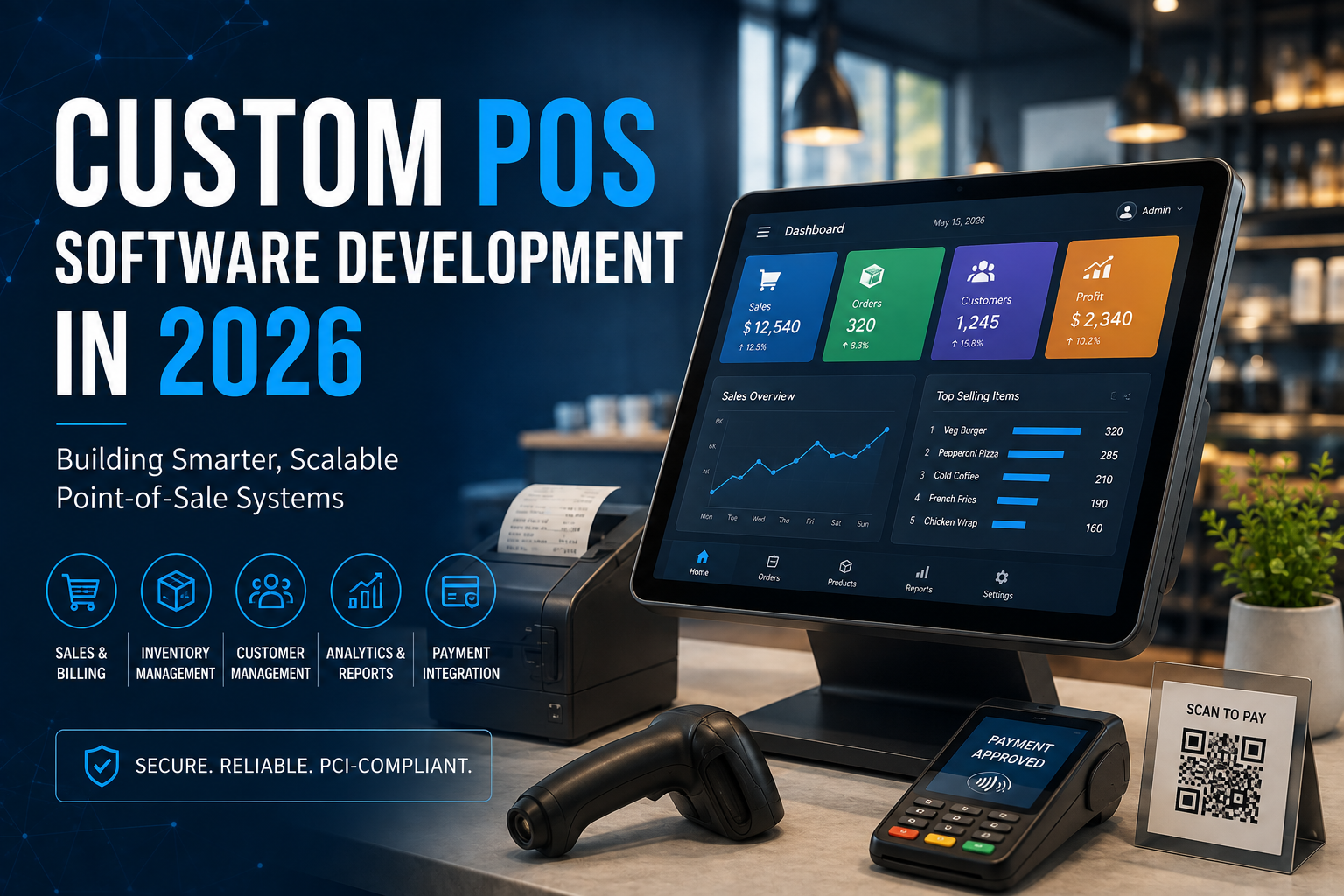
Point-of-sale software has evolved far beyond simply processing transactions. In 2026, businesses expect their POS systems to connect payments, inventory, customer data, analytics, staff operations, and multiple sales channels into one intelligent platform.
For restaurants, retailers, hospitality businesses, and growing enterprises, off-the-shelf POS software can become restrictive when workflows, integrations, or reporting requirements become more complex. This is where custom POS software development provides a major advantage.
Modern POS platforms are increasingly becoming business-management systems rather than simple checkout tools. Industry research shows that 90% of restaurants surveyed identified stronger system integration as a top strategic POS goal, while 33% planned to add AI-driven capabilities to their existing POS environments.
What Is Custom POS Software?
Custom POS software is a point-of-sale solution developed specifically around a company’s operational requirements.
Instead of forcing a business to change its processes to match a pre-built product, custom POS development allows the software to be designed around existing workflows.
A custom POS system can include:
- Billing and checkout
- Inventory management
- Customer management
- Employee and role management
- Multi-location management
- Online ordering
- Payment integration
- Loyalty programs
- Advanced analytics
- Accounting integrations
- CRM integration
- Delivery management
- Barcode and QR-code scanning
- Kitchen management
- Real-time dashboards
This flexibility makes custom POS particularly useful for businesses with specialized workflows or plans to scale across multiple locations.
Why Businesses Are Moving Toward Custom POS Systems in 2026
The modern customer can interact with a business through several channels—physical stores, websites, mobile applications, marketplaces, delivery platforms, kiosks, and QR-based ordering.
A POS system must bring these channels together rather than treating each one as a separate operation.
Modern restaurant POS systems, for example, increasingly connect front-of-house service, kitchen operations, inventory, customer data, and management analytics.
Custom development allows businesses to create this connected ecosystem according to their exact requirements.
1. Greater Control Over Business Workflows
Every business operates differently.
A restaurant chain may need table management and kitchen integration, while a retail company may require advanced inventory, barcode scanning, purchase orders, and warehouse management.
Custom POS software can be designed around these specific workflows.
2. Better Integration Capabilities
Businesses rarely use only one software platform.
A POS may need to communicate with:
- Payment gateways
- Accounting software
- CRM platforms
- ERP systems
- E-commerce stores
- Delivery platforms
- Loyalty applications
- Inventory systems
- Customer-support tools
- Business intelligence platforms
A custom POS solution can be built with APIs and integration layers that connect these systems into a unified environment.
3. AI-Powered Business Intelligence
AI is becoming one of the most important developments in modern POS technology.
In 2026, restaurant operators are already using AI-powered POS capabilities for sales analysis, menu optimization, inventory management, labor efficiency, and operational recommendations.
A custom POS platform can use AI to help businesses:
- Forecast product demand
- Identify slow-moving inventory
- Predict busy periods
- Recommend menu changes
- Detect unusual transactions
- Analyze customer purchasing behavior
- Identify sales trends
- Improve staff scheduling
- Generate automated business reports
The goal isn’t simply to add an AI chatbot. The real value comes from connecting AI to actual business data.
Security Should Be Designed Into the POS
Payment security cannot be treated as an afterthought.
PCI DSS provides baseline technical and operational requirements designed to protect payment account data, and its scope includes organizations that store, process, transmit, or can impact the security of cardholder data.
For businesses developing custom payment functionality, security should be considered throughout the software development lifecycle.
Important practices include:
- Secure authentication
- Role-based access controls
- Encryption
- Tokenization where appropriate
- Secure API communication
- Vulnerability management
- Logging and monitoring
- Secure software development practices
- Regular security testing
- Controlled access to sensitive payment data
The PCI Security Standards Council also recommends that payment software be developed using appropriate secure software practices and standards.
Important: PCI compliance depends on the specific architecture, payment flow, integrations, and responsibilities of the merchant and service providers. A development company should not simply label a POS application “PCI compliant” without understanding the actual compliance scope.
Cloud-Based POS Is Becoming Essential
Cloud architecture gives businesses access to centralized data and management tools across locations.
For multi-store businesses, a cloud-based POS can provide:
Centralized Management → Real-Time Data → Multi-Location Visibility → Faster Decisions
Managers can monitor sales, inventory, employee activity, and operational performance without being physically present at every location.
Cloud infrastructure can also make software updates and feature deployment more efficient compared with traditional systems that require manual updates at individual terminals.
Offline Mode Still Matters
Cloud connectivity is important, but businesses cannot always depend on a perfect internet connection.
A well-designed POS should consider offline operation for critical workflows.
For example, a restaurant may still need to:
- Create an order.
- Print or send the order to the kitchen.
- Complete essential billing operations.
- Store the transaction securely.
- Synchronize data once connectivity returns.
Offline-first or resilient architecture can prevent network interruptions from becoming operational disasters.
Real-Time Inventory Management
Inventory is one of the biggest areas where POS software can create measurable business value.
A modern custom POS can connect sales with inventory movement.
For example:
Sale → Inventory Update → Low-Stock Alert → Purchase Planning
Businesses can monitor:
- Current stock
- Product movement
- Low-stock items
- Wastage
- Stock adjustments
- Purchase orders
- Supplier information
- Product profitability
For restaurants, inventory can go even deeper by connecting menu sales with ingredient consumption.
Customer Data and Loyalty
A POS system can become an important source of customer intelligence.
With the right architecture, businesses can understand:
- Purchase frequency
- Average order value
- Favorite products
- Visit patterns
- Promotion response
- Customer lifetime value
This information can power personalized loyalty campaigns and targeted promotions.
For example, instead of sending the same discount to every customer, a business could create campaigns based on purchasing behavior.
Advanced POS Analytics
Traditional POS reports answer questions such as:
“How much did we sell today?”
Modern POS analytics should help answer:
“Why did sales change, and what should we do next?”
A custom analytics dashboard can provide:
- Daily and monthly sales
- Product performance
- Category performance
- Employee performance
- Location comparison
- Payment-method analysis
- Peak-hour analysis
- Inventory trends
- Profitability insights
- Customer behavior
This transforms POS data from historical reporting into a decision-making tool.
Custom POS for Multi-Location Businesses
Scaling a business often exposes the limitations of basic POS software.
A multi-location organization may require:
- Centralized product management
- Location-specific pricing
- Central inventory controls
- Individual staff permissions
- Branch-level reporting
- Centralized customer profiles
- Consolidated analytics
- Location-specific promotions
A custom architecture can be designed to support these requirements from the beginning, making future expansion easier.
POS + Mobile Apps + Web Dashboards
The POS doesn’t have to be limited to a desktop terminal.
A modern ecosystem can include:
POS Terminal + Mobile App + Admin Dashboard + Customer App + Cloud Backend
For example:
- Employees use the POS terminal.
- Managers monitor operations through a web dashboard.
- Customers place orders through a mobile application.
- Owners review business performance from their phone.
- The backend synchronizes data across the entire ecosystem.
This creates a connected business platform rather than an isolated billing application.
How to Build a Custom POS System
A successful custom POS project generally follows several stages.
Step 1: Business Requirement Analysis
Identify the business model, workflows, users, integrations, payment requirements, and scalability needs.
Step 2: UX/UI Design
Create intuitive interfaces for cashiers, managers, administrators, kitchen staff, and customers where required.
Step 3: Technology Architecture
Define the backend, database, APIs, cloud infrastructure, security architecture, and frontend technologies.
Step 4: Core POS Development
Develop essential functionality such as products, billing, orders, inventory, users, payments, and reporting.
Step 5: Third-Party Integrations
Connect payment gateways, accounting platforms, CRM systems, delivery services, e-commerce platforms, and other required services.
Step 6: Security and Testing
Conduct functional, performance, API, security, and usability testing.
Step 7: Deployment
Deploy the platform using an appropriate cloud or hybrid architecture.
Step 8: Continuous Improvement
Monitor performance and introduce new capabilities such as AI analytics, automation, loyalty, and advanced reporting.
How Much Does Custom POS Development Cost?
The cost depends heavily on the scope of the system.
A basic POS may include:
- Product management
- Billing
- User accounts
- Basic reports
A more advanced platform may require:
- Multi-location support
- Inventory management
- Payment integrations
- Mobile applications
- Customer loyalty
- AI analytics
- Accounting integration
- Delivery integration
- Offline functionality
- Advanced security
- Custom dashboards
Therefore, there is no single price that applies to every custom POS project.
The best approach is to define the required features first and then estimate development, infrastructure, integration, testing, maintenance, and future scaling costs.
Custom POS vs Off-the-Shelf POS
| Feature | Custom POS | Off-the-Shelf POS |
|---|---|---|
| Business-specific workflows | High flexibility | Limited |
| Custom integrations | Flexible | Depends on provider |
| UI customization | Extensive | Usually limited |
| Scalability | Designed around requirements | Depends on platform |
| Feature control | Full | Vendor controlled |
| Initial investment | Usually higher | Usually lower |
| Long-term flexibility | High | Varies |
| AI customization | Can be purpose-built | Depends on vendor |
The right choice depends on business size, budget, complexity, integration requirements, and long-term goals.
The Future of Custom POS Development
POS software is moving toward intelligent, connected, and automated business platforms.
AI, cloud computing, real-time analytics, mobile payments, automation, and omnichannel commerce will continue influencing POS development.
The biggest opportunity isn’t simply creating a faster checkout screen.
It is building a system that connects transactions, customers, inventory, employees, payments, analytics, and business decisions.
For businesses with complex requirements, custom POS software can provide the flexibility needed to build that connected ecosystem.
Final Thoughts
In 2026, a POS system should do much more than generate receipts.
Businesses need technology that can manage operations, connect multiple channels, protect sensitive information, provide actionable insights, and scale as the organization grows.
Custom POS software development provides the flexibility to build these capabilities around specific business requirements rather than forcing the business to adapt to a generic platform.
If your business has outgrown traditional POS software, a custom solution can be an opportunity to turn your point-of-sale system into a complete digital operations platform.
Comments