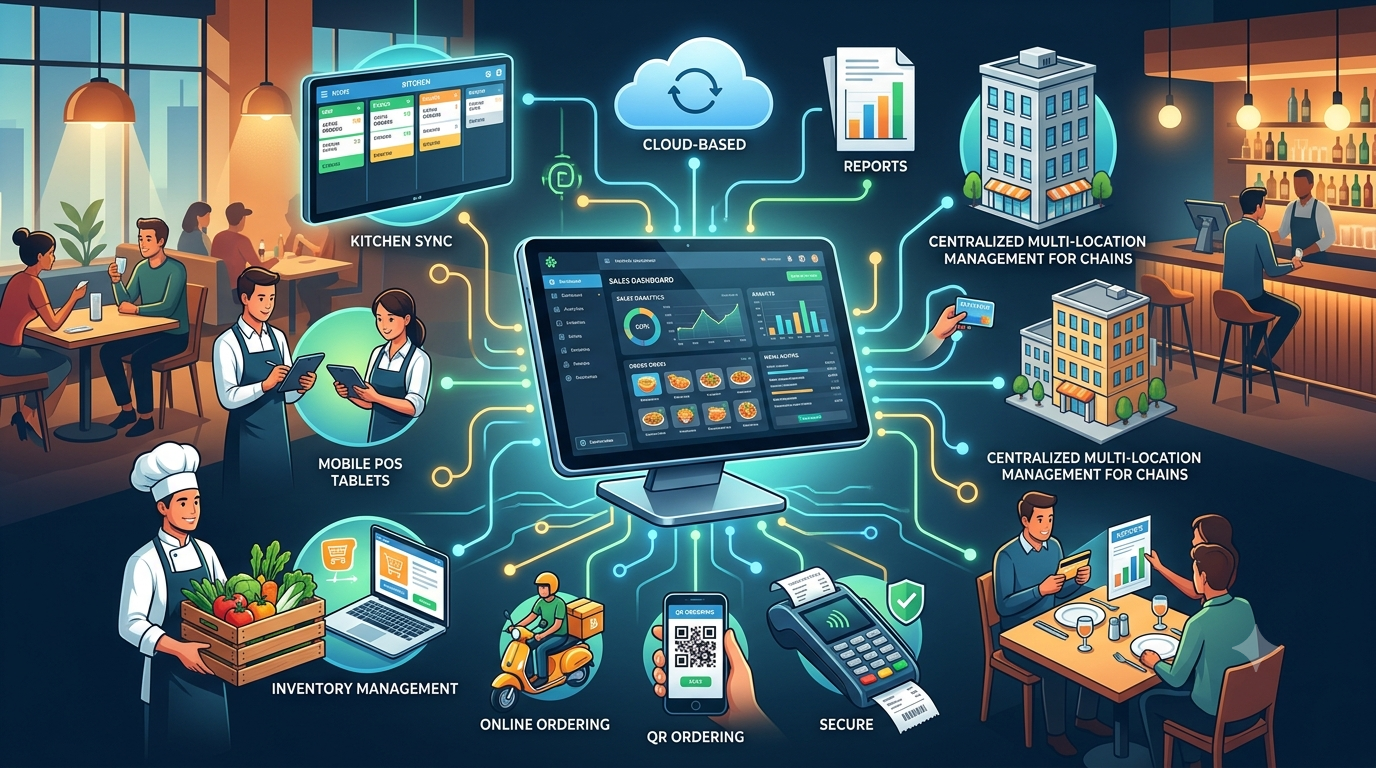
Running a restaurant today is about much more than taking orders and processing payments. Restaurant owners need to manage tables, staff, inventory, customer data, online orders, payments, and reporting—all while delivering a smooth customer experience.
This is where modern POS software has become an essential part of restaurant operations.
A powerful restaurant POS system can connect different parts of the business into one centralized platform, helping restaurants reduce manual work, improve accuracy, and make faster decisions.
What Is a Modern Restaurant POS System?
A Point-of-Sale system is traditionally associated with billing and payment processing.
Modern POS platforms go much further.
A restaurant POS can connect:
Orders → Kitchen → Tables → Payments → Inventory → Customers → Reports
Instead of using separate systems for each process, restaurant businesses can manage many day-to-day operations through a single platform.
For restaurant chains and growing businesses, this centralized approach can be especially valuable.
Why Restaurants Are Moving Beyond Traditional POS Software
Older POS systems were primarily designed to process transactions.
Today’s restaurants expect their technology to help with the entire operation.
A modern POS system can help businesses:
- Process orders faster
- Manage tables
- Track inventory
- Reduce billing errors
- Manage employees
- Integrate online orders
- Monitor sales
- Analyze restaurant performance
- Manage multiple locations
- Improve customer experiences
The POS is increasingly becoming the operational hub of the restaurant.
1. Cloud-Based POS Is Becoming Essential
Cloud technology is changing how restaurants access business information.
With a cloud-based POS system, authorized users can access important information from different locations.
Restaurant owners can potentially monitor:
- Daily sales
- Product performance
- Inventory
- Staff activity
- Order volume
- Location performance
For restaurant groups, centralized access can make managing multiple branches significantly easier.
2. Inventory Management Is Moving Closer to the POS
Food waste and inventory inaccuracies can significantly affect restaurant profitability.
Modern POS systems can connect sales information with inventory management.
For example:
Sale → Inventory Update → Stock Monitoring → Reorder Decision
When an item is sold, the system can update relevant inventory information.
This can help restaurant operators identify:
- Fast-moving products
- Low-stock ingredients
- Overstocked items
- Popular menu items
- Potential wastage
Better visibility can help businesses make more informed purchasing decisions.
3. Kitchen Integration Improves Order Flow
The connection between the front of the restaurant and the kitchen is critical.
A modern POS can integrate with a Kitchen Display System (KDS) to digitally send orders to kitchen staff.
Instead of relying entirely on printed tickets or verbal communication, kitchen teams can receive structured order information directly on a screen.
This can help improve:
- Order accuracy
- Kitchen organization
- Preparation workflows
- Communication between staff
- Order tracking
For busy restaurants, even small improvements in kitchen efficiency can make a meaningful difference.
4. Online Ordering and POS Integration
Customers increasingly expect restaurants to offer digital ordering options.
Restaurants may receive orders through:
- Websites
- Mobile applications
- Online ordering platforms
- QR codes
- In-store ordering systems
A modern POS can help centralize these orders.
Instead of managing multiple disconnected systems, restaurants can bring more order information into a unified workflow.
5. QR Code Ordering Is Changing the Dining Experience
QR-based ordering has become increasingly popular in restaurants.
Customers can scan a QR code at their table and access a digital menu.
Depending on the POS ecosystem, they may be able to:
- Browse the menu
- Customize items
- Place orders
- Request additional items
- Make payments
This can reduce pressure on restaurant staff during busy periods while giving customers more control over their dining experience.
6. Self-Service Ordering
Self-service technology is another area where POS systems are evolving.
Restaurants can use self-service kiosks or digital ordering interfaces to allow customers to place orders independently.
This approach can be useful for:
- Quick-service restaurants
- Cafés
- Food courts
- Fast-casual restaurants
- High-volume locations
The objective isn’t necessarily to replace staff.
Instead, technology can help staff focus on food preparation, customer service, and other higher-value activities.
7. Mobile POS for Faster Service
Traditional POS terminals are no longer the only option.
Mobile POS applications can allow restaurant employees to take orders from different locations.
For example, servers can use tablets or mobile devices to enter orders directly at the table.
This can reduce the time between:
Customer Order → POS → Kitchen
It can also reduce errors caused by handwritten orders or repeated data entry.
8. Customer Data Is Becoming More Valuable
A POS system can provide restaurants with valuable information about customer behavior.
Depending on the implementation, businesses can analyze:
- Purchase history
- Order frequency
- Popular products
- Average order value
- Customer preferences
- Visit patterns
Restaurants can use this information to develop more personalized promotions and loyalty strategies.
9. Loyalty Programs Integrated With POS
Restaurant loyalty programs can become more effective when connected directly with POS software.
Customers may earn points or rewards based on their purchases.
A connected loyalty system can help businesses:
- Encourage repeat visits
- Reward loyal customers
- Track customer activity
- Create targeted promotions
- Increase customer engagement
The important factor is integration.
When loyalty, ordering, and payment data exist within connected systems, businesses can create a more consistent customer experience.
10. Analytics Are Becoming a Core POS Feature
Restaurants generate large amounts of operational data every day.
Modern POS analytics can help transform that data into useful insights.
Restaurant owners may want to understand:
Which products sell the most?
Which hours generate the highest revenue?
Which location performs best?
Which menu items have declining sales?
What is the average order value?
Data-driven reporting can help restaurant managers make decisions based on actual business performance rather than assumptions.
POS Systems for Restaurant Chains
Managing a single restaurant is challenging.
Managing multiple locations introduces another level of complexity.
Restaurant chains need centralized systems for:
- Menu management
- Pricing
- Inventory
- Sales reporting
- Employee management
- Promotions
- Customer data
- Location performance
A scalable POS system for restaurant chains can provide centralized visibility while still allowing individual locations to operate efficiently.
Security and Payment Processing
Payment security is another important consideration when selecting or developing POS software.
A modern restaurant POS ecosystem may handle sensitive information involving:
- Payments
- Customers
- Employees
- Business operations
Businesses should consider:
- Secure authentication
- User permissions
- Encrypted communication
- Secure APIs
- Payment security
- Data protection
- Audit logs
- Regular software updates
Security should be part of the POS architecture from the beginning.
What Should Businesses Look for in POS Software?
Before selecting or developing a restaurant POS system, businesses should evaluate several factors.
Scalability
Can the system support additional terminals, locations, and users?
Integration
Can it integrate with accounting, payments, inventory, delivery, loyalty, and other systems?
Usability
Can restaurant employees learn the system quickly?
Reporting
Does it provide meaningful operational and financial insights?
Reliability
Can the system continue functioning during connectivity problems?
Security
Does it follow appropriate payment and data-security practices?
Customization
Can the platform adapt to the restaurant’s specific workflow?
These factors are often more important than simply choosing the system with the longest feature list.
The Future of Restaurant POS
The next generation of restaurant POS platforms will likely become increasingly intelligent.
We can expect greater use of:
- AI-powered analytics
- Automated inventory forecasting
- Predictive ordering
- Personalized promotions
- Digital menus
- Contactless payments
- Self-service kiosks
- Mobile POS
- Cloud platforms
- Multi-location management
- Automated reporting
The POS will increasingly function as a restaurant intelligence platform, rather than simply a billing machine.
Building a Custom POS for Your Restaurant Business
Every restaurant operates differently.
A small café may need a simple billing and inventory system, while a large restaurant chain may require centralized management, multi-location reporting, online ordering, loyalty, kitchen integration, and advanced analytics.
This is where custom POS development can provide an advantage.
A custom POS solution can be designed around the specific workflow of a business rather than forcing the business to adapt to a generic platform.
A complete custom restaurant POS ecosystem could include:
POS Terminal + Mobile POS + Kitchen Display + Online Ordering + Inventory + CRM + Loyalty + Payments + Analytics
Comments