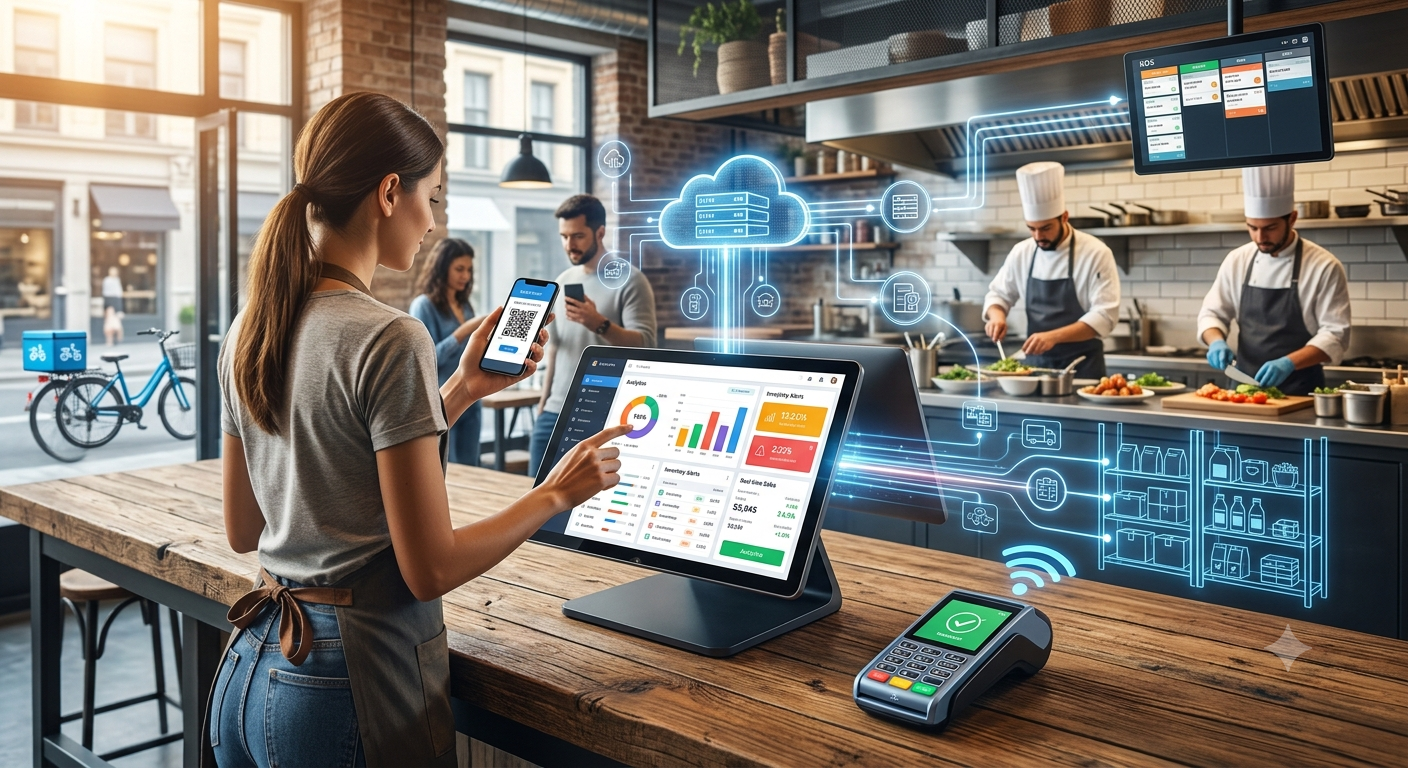
The restaurant industry is changing quickly.
Customers expect faster service, convenient ordering, accurate bills, personalized experiences, and multiple payment options. At the same time, restaurant owners need to control food costs, manage inventory, reduce waste, and understand what is happening across every location.
Traditional billing software can handle transactions, but modern restaurants need much more.
This is why AI-powered POS systems are becoming an important part of restaurant technology.
A smart restaurant POS can connect sales, inventory, customers, employees, orders, payments, and analytics in one centralized platform—helping restaurant businesses make faster and more informed decisions.
What Is an AI-Powered Restaurant POS?
An AI-powered POS system combines traditional point-of-sale functionality with artificial intelligence, automation, analytics, and cloud technology.
Instead of simply recording a transaction, an intelligent POS can help restaurants understand their business.
For example, it can analyze:
- Sales patterns
- Popular menu items
- Customer purchasing behavior
- Inventory movement
- Peak ordering periods
- Product performance
- Location-level performance
- Order trends
The result is a POS system that becomes a business intelligence tool, not just a billing machine.
1. Smarter Sales Forecasting
One of the biggest advantages of intelligent POS technology is the ability to analyze historical sales data.
Restaurants can identify patterns such as:
Which products sell the most?
What time of day generates the highest orders?
Which days are typically busy?
Which menu items are losing popularity?
These insights can help restaurant managers make better decisions about staffing, inventory, promotions, and menu planning.
Instead of relying entirely on intuition, restaurant owners can use data from their POS system to support operational decisions.
2. Automated Inventory Management
Inventory management is one of the biggest challenges for restaurants.
Too much inventory can lead to waste.
Too little inventory can result in unavailable menu items and unhappy customers.
A modern POS can connect sales data with inventory information to provide a clearer view of stock movement.
For example:
Order Received → Item Sold → Inventory Updated → Stock Level Monitored
With automation, restaurant managers can spend less time manually updating spreadsheets and more time focusing on operations.
3. Reducing Food Waste
Food waste directly affects restaurant profitability.
Smart POS and inventory systems can help businesses identify products that are frequently overstocked or underutilized.
By analyzing sales trends, restaurants can improve purchasing decisions and better align inventory with actual demand.
Over time, this can help restaurants reduce unnecessary waste and improve cost control.
4. Personalized Customer Experiences
Customer expectations are changing.
People increasingly expect restaurants to understand their preferences and provide convenient experiences.
A modern POS can help businesses maintain useful customer information such as:
- Order history
- Favorite products
- Visit frequency
- Loyalty activity
- Promotions
- Purchase patterns
Restaurants can use these insights to create more relevant loyalty programs and marketing campaigns.
For example, a restaurant could identify customers who frequently order a particular category and create targeted promotions around related products.
5. Faster Restaurant Operations
Speed matters in the restaurant business.
A slow ordering or payment process can create queues and negatively affect the customer experience.
Modern POS platforms can streamline:
- Table orders
- Counter orders
- Online orders
- Takeaway orders
- Delivery orders
- Payments
- Receipts
- Kitchen communication
When different parts of the restaurant ecosystem are connected, employees can spend less time switching between systems.
6. Better Multi-Location Management
Managing one restaurant is challenging.
Managing ten, fifty, or hundreds of locations is even more complicated.
Restaurant chains need centralized visibility across their operations.
A cloud-based POS can allow businesses to monitor important information across multiple locations from a centralized platform.
Management teams can compare:
- Revenue
- Orders
- Menu performance
- Inventory
- Customer activity
- Store performance
This provides restaurant chains with a more consistent view of their entire business.
7. Integrated Payment Processing
Payments are an essential part of every restaurant transaction.
Modern POS platforms can integrate different payment methods, allowing restaurants to create smoother checkout experiences.
Depending on the business model, this can include:
- Credit and debit cards
- Contactless payments
- Digital wallets
- Online payments
- QR-based payments
- Integrated payment terminals
Payment integration can also reduce the need for employees to manually enter transaction information.
8. Real-Time Restaurant Analytics
Restaurant owners don’t want to wait until the end of the month to understand their business.
Modern POS dashboards can provide access to real-time or near-real-time operational information.
Managers can monitor:
Sales → Orders → Inventory → Customers → Staff → Locations
This makes it easier to identify problems quickly and respond to changing business conditions.
9. AI Can Help Restaurants Make Better Decisions
AI shouldn’t replace restaurant managers.
It should help them make better decisions.
For example, an intelligent POS could identify that:
- A particular menu item is becoming more popular.
- A location is experiencing unusual sales growth.
- Certain inventory items are moving slowly.
- Weekend demand is consistently higher.
- A promotion is generating more purchases.
These insights can help restaurant businesses move from reactive management to proactive decision-making.
What Should Restaurants Look for in a Modern POS?
Restaurants considering a new POS system should look beyond basic billing features.
Important capabilities can include:
Cloud-Based Architecture
Access business information from different locations while maintaining centralized management.
Inventory Management
Track stock movement and connect inventory with sales activity.
Customer Management
Build customer profiles and support loyalty initiatives.
Multi-Location Support
Manage multiple restaurants through a centralized platform.
Reporting & Analytics
Turn transaction data into useful business insights.
Payment Integration
Support secure and convenient payment experiences.
Online Ordering Integration
Connect digital orders with restaurant operations.
Scalability
Choose technology that can grow as the restaurant business expands.
Why Custom POS Development Can Be a Better Choice
Every restaurant business operates differently.
A quick-service restaurant may need a different workflow than a fine-dining restaurant.
A restaurant chain may require centralized management, while a small restaurant may prioritize simplicity and affordability.
This is where custom POS software development can provide an advantage.
Instead of forcing a business to change its operations around generic software, a custom POS solution can be designed around the restaurant’s specific workflows.
Custom POS development can include integrations with:
- Restaurant websites
- Mobile applications
- Payment systems
- Kitchen displays
- Inventory platforms
- Accounting software
- Loyalty programs
- Delivery platforms
- CRM systems
The Future of Restaurant POS Technology
The future of restaurant technology is moving toward connected and intelligent platforms.
POS systems will increasingly become the central technology layer connecting:
Customers + Orders + Payments + Inventory + Staff + Analytics + AI
This means restaurants can use one connected ecosystem to understand their business and improve operations.
The most successful restaurant technology platforms won’t simply process transactions.
They will help restaurants understand their customers, optimize operations, control costs, and grow more efficiently.
Conclusion
The modern restaurant POS is evolving from a simple billing system into a powerful business management platform.
With AI, cloud computing, automation, analytics, integrated payments, and customer intelligence, restaurants can create faster and more efficient operations while delivering better customer experiences.
For restaurant owners planning their next technology investment, the question shouldn’t simply be:
“Which POS system can process my payments?”
A better question is:
“Which POS technology can help my restaurant grow?”
A smart, scalable, and customized POS platform can become the foundation for that growth.
SEO Keywords
- AI restaurant POS system
- restaurant POS software
- smart POS system
- AI-powered POS
- custom POS development
- restaurant management software
- cloud POS system
- restaurant technology solutions
- POS software development
- restaurant POS development
- multi-location restaurant POS
- intelligent restaurant management system
Meta Title
AI-Powered POS Systems: The Future of Smart Restaurant Management
Meta Description
Discover how AI-powered POS systems are helping restaurants improve sales forecasting, inventory, customer experiences, payments, analytics, and multi-location management.
Comments