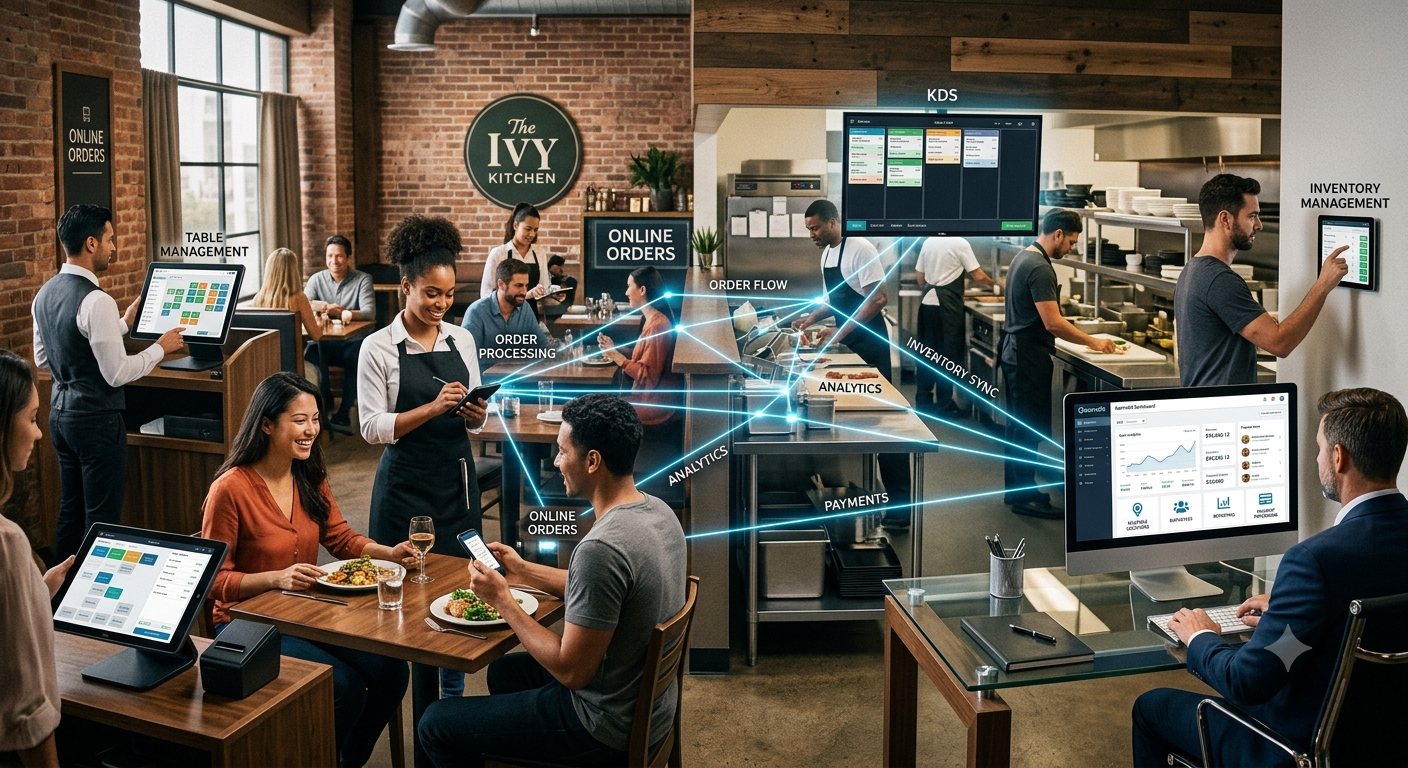
Running a restaurant today involves much more than taking orders and collecting payments.
Restaurant owners need to manage inventory, employees, tables, online orders, customer data, payments, reporting, and multiple locations—all while delivering a fast and seamless customer experience.
This is where modern restaurant POS software is becoming an essential business tool.
Unlike traditional billing systems that mainly process transactions, today’s POS platforms can connect different parts of a restaurant operation into one centralized system.
What Is Modern Restaurant POS Software?
A modern restaurant POS system combines billing and payment processing with operational tools such as:
- Order management
- Table management
- Inventory tracking
- Employee management
- Customer management
- Online ordering
- Sales analytics
- Multi-location management
- Digital receipts
- Payment integrations
Instead of using separate systems for every function, restaurants can manage their daily operations from a single platform.
1. Faster Order Processing
Speed matters in the restaurant business.
A modern POS system allows servers and staff to enter orders quickly, send them directly to kitchen stations, modify items, and process payments without unnecessary steps.
This can help restaurants:
- Reduce order-entry mistakes
- Improve table turnover
- Minimize customer waiting time
- Improve communication between front and back of house
For busy restaurants, even a small improvement in order processing can make a significant operational difference.
2. Better Inventory Management
Food waste and inventory costs can significantly affect restaurant profitability.
Modern POS software can connect sales information with inventory management, helping restaurant operators understand which ingredients and products are being consumed.
Restaurant managers can monitor:
- Ingredient usage
- Stock levels
- Popular menu items
- Low-stock products
- Food waste
- Purchasing requirements
This gives management better visibility into food costs and helps them make more informed purchasing decisions.
3. Real-Time Restaurant Analytics
Making decisions based on assumptions can be expensive.
A modern POS system provides access to sales and operational data that restaurant owners can use to understand business performance.
Reports can help answer questions such as:
Which menu items sell the most?
What are the busiest hours?
Which location generates the most revenue?
How are sales changing over time?
Which payment methods are customers using?
With this information, restaurant owners can make data-driven decisions instead of relying only on intuition.
4. Improved Customer Experience
Technology should make restaurant experiences easier—not more complicated.
Modern POS systems can support faster checkout, digital receipts, multiple payment options, online ordering, and customer management.
Restaurants can also use customer information to understand purchasing patterns and create more personalized experiences.
A smoother ordering and payment process can contribute to better customer satisfaction and repeat business.
5. Supporting Multiple Restaurant Locations
Managing one restaurant is challenging.
Managing five, ten, or fifty locations is considerably more complex.
A multi-location POS system can provide centralized visibility across different restaurants.
Business owners can monitor:
- Revenue by location
- Sales performance
- Menu performance
- Inventory
- Staff activity
- Payment transactions
- Operational trends
Centralized reporting makes it easier for restaurant groups to compare locations and identify opportunities for improvement.
6. Integration With Online Ordering
Restaurant customers increasingly expect convenient ordering options.
A modern POS platform can integrate with digital ordering channels so restaurants can manage orders more efficiently.
Instead of manually entering online orders into the POS, integrated systems can reduce duplicate work and minimize the risk of human error.
This becomes especially important for restaurants handling large volumes of takeaway and delivery orders.
7. Secure Payment Processing
Payment security is another critical part of restaurant technology.
Restaurants process large numbers of card and digital transactions every day, making secure payment infrastructure essential.
Modern POS solutions can support secure payment integrations and help businesses create a more reliable checkout experience.
For restaurants handling payment card information, choosing technology with appropriate security and compliance capabilities should be a major consideration.
8. Employee Management
Restaurant operations depend heavily on employees.
Modern POS systems can provide tools for managing staff activity, permissions, shifts, and sales performance.
Managers can use POS data to better understand:
- Employee sales
- Working hours
- Transaction activity
- Discounts and voids
- Staff permissions
This can improve operational visibility and help management identify unusual activity or areas requiring additional training.
9. Customization Matters
Every restaurant operates differently.
A quick-service restaurant doesn’t have the same workflow as a fine-dining restaurant. A café has different requirements from a large restaurant chain.
This is why custom POS software can be valuable.
Instead of forcing a business to change its workflow around generic software, a customized POS solution can be designed around specific operational requirements.
Customization can include:
- Restaurant-specific workflows
- Custom reporting
- Third-party integrations
- Specialized payment requirements
- Custom inventory logic
- Multi-location functionality
- Industry-specific features
The Future of Restaurant POS Technology
Restaurant POS technology is moving toward becoming more than a billing tool.
AI, automation, cloud technology, advanced analytics, digital ordering, and connected devices are helping POS platforms become central technology hubs for restaurant operations.
Future-focused restaurants will increasingly use POS data to understand customers, optimize inventory, improve staffing decisions, and identify revenue opportunities.
The goal isn’t simply to process more transactions.
The goal is to run the entire restaurant operation more intelligently.
Why Restaurants Should Invest in Modern POS Software
A restaurant POS system is no longer just a cash register replacement.
It can become the operational foundation connecting sales, payments, inventory, employees, customers, and business intelligence.
For growing restaurants, the right technology can provide:
Better efficiency + Better visibility + Better customer experience + Better decision-making
That’s why investing in a modern POS platform can be an important step toward long-term restaurant growth.
Final Thoughts
The restaurant industry is becoming increasingly technology-driven.
From cloud-based management to AI-powered analytics and integrated payments, modern POS software is helping restaurants simplify complex operations and respond faster to changing customer expectations.
For restaurant owners planning their next stage of growth, the question is no longer whether they need POS technology.
The real question is:
Does your POS system have the capabilities your restaurant will need tomorrow?
A modern, scalable, and customizable POS solution can help restaurants build a stronger technology foundation for the future.
Comments