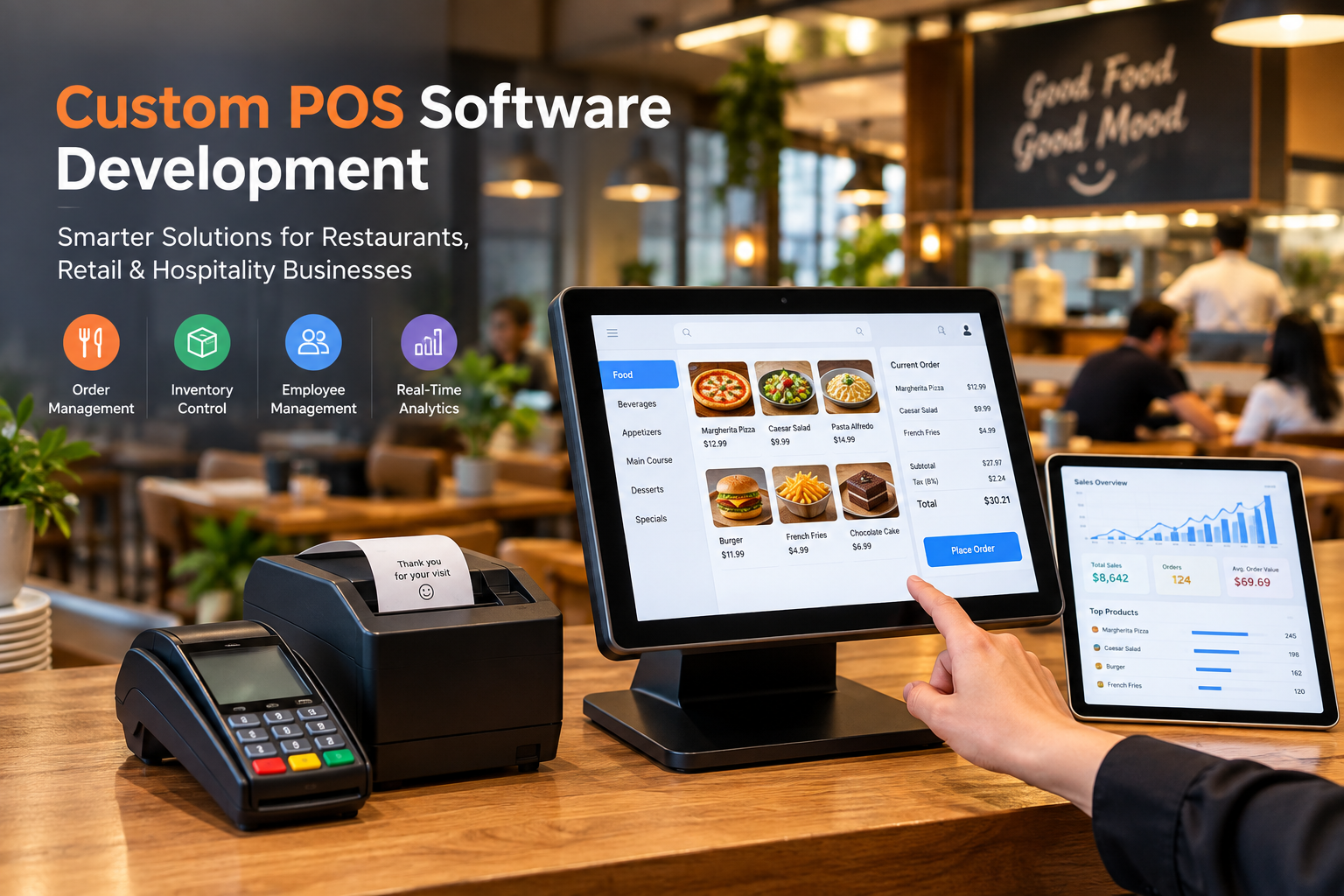
The point-of-sale system is no longer just a tool for processing payments.
Modern restaurants, retail stores, hotels, cafés, and multi-location businesses need POS software that can manage orders, inventory, employees, customer data, payments, reporting, and business operations from a single platform.
While off-the-shelf POS solutions can work for basic requirements, growing businesses often need more flexibility. This is where custom POS software development becomes valuable.
A custom POS system is designed around the specific workflows, integrations, and business goals of an organization instead of forcing the business to adapt to a generic platform.
What Is Custom POS Software Development?
Custom POS software development is the process of designing and building a point-of-sale solution specifically for a company’s operational requirements.
Instead of using the same features and workflows as every other business, organizations can develop a POS platform with capabilities such as:
- Restaurant order management
- Retail checkout
- Inventory management
- Employee management
- Customer loyalty programs
- Payment gateway integration
- Kitchen display systems
- Online ordering
- Multi-location management
- Advanced analytics
- CRM integration
- Accounting integration
- Cloud-based reporting
This makes custom POS development particularly useful for businesses with complex operations or specialized requirements.
Why Are Businesses Moving Toward Custom POS Systems?
The POS market is becoming increasingly connected with cloud computing, automation, artificial intelligence, mobile applications, and real-time analytics.
Businesses now expect their POS system to do more than generate receipts.
A modern POS platform can become the central technology hub connecting sales, inventory, customers, employees, payments, and business intelligence.
1. Complete Business Customization
Every business operates differently.
A restaurant may need table management and kitchen order routing, while a retail company may require barcode scanning, product variants, and warehouse management.
Custom POS software allows businesses to build workflows around their actual operations.
2. Better Integration Capabilities
Businesses often use multiple technology platforms.
A custom POS system can integrate with:
- Payment gateways
- Accounting software
- CRM platforms
- E-commerce websites
- Mobile applications
- Delivery platforms
- Loyalty programs
- Inventory systems
- ERP software
- Hardware devices
These integrations reduce manual data entry and create a connected business ecosystem.
3. Improved Operational Efficiency
Automation can reduce repetitive tasks.
For example, when a customer completes an order, the POS can automatically update inventory, send information to the kitchen, process payment, generate a receipt, and record the transaction.
This creates a smoother workflow for employees and customers.
Key Features of a Modern Custom POS System
A successful POS platform should be designed around the company’s industry and operational requirements.
Point-of-Sale and Checkout
The core POS module should provide fast and reliable transaction processing.
Important capabilities can include:
- Product and service management
- Barcode scanning
- Discounts
- Taxes
- Multiple payment methods
- Digital receipts
- Refunds and exchanges
- Cash management
Inventory Management
Inventory visibility is critical for restaurants and retailers.
A custom POS solution can provide:
- Real-time inventory tracking
- Low-stock alerts
- Purchase order management
- Stock transfers
- Supplier management
- Product-level reporting
- Automated inventory updates
For restaurants, inventory management can also be connected with ingredients and recipe-level consumption.
Restaurant POS Features
Restaurant businesses have specialized requirements.
A restaurant POS system can include:
- Table management
- Dine-in and takeaway orders
- Online ordering
- Kitchen display system integration
- Menu management
- Split billing
- Multiple payment options
- Customer profiles
- Delivery management
- Digital receipts
A well-designed restaurant POS can connect the front-of-house, kitchen, management, and accounting workflows.
Employee Management
Businesses can also integrate employee functionality into their POS.
Features may include:
- Employee accounts
- Role-based permissions
- Attendance
- Shift management
- Sales performance
- Commission tracking
- Activity monitoring
Role-based access helps ensure that employees only have access to the functions they need.
AI-Powered POS Software Is the Next Step
Artificial intelligence is becoming an important component of modern business software.
An AI-powered POS system can analyze historical transactions and operational data to provide useful business insights.
For example, AI can help identify:
- Best-selling products
- Slow-moving inventory
- Busy sales periods
- Customer purchasing patterns
- Potential inventory shortages
- Sales trends
- Product recommendations
For restaurant businesses, AI can also help analyze menu performance and demand patterns.
The objective is not simply to add AI to a POS system. The real value comes from using business data to support better decisions.
Cloud-Based Custom POS Development
Cloud technology has changed how businesses manage POS systems.
With a cloud-based POS architecture, authorized users can access business information from different locations and devices.
This is particularly useful for businesses operating multiple stores or restaurant locations.
Management teams can monitor:
- Sales
- Inventory
- Revenue
- Employee activity
- Product performance
- Location-wise performance
from a centralized dashboard.
Mobile POS Applications
Mobile POS solutions are becoming increasingly popular.
Businesses can develop POS applications for tablets and smartphones to support flexible checkout and order management.
For example, restaurant employees can use tablets to take orders directly from tables, while retail employees can assist customers anywhere inside a store.
Mobile POS development can also support:
- Android devices
- iOS devices
- Tablets
- Handheld scanners
- Mobile payment hardware
Secure Payment Processing
Security should be a core part of POS software development.
A modern POS system should be designed with appropriate security controls for protecting customer and transaction information.
Depending on the payment architecture and business requirements, developers may implement:
- Secure authentication
- Role-based access
- Data encryption
- Tokenization
- Secure APIs
- Audit logs
- PCI-related security requirements
Businesses should work with experienced developers when building POS platforms that handle payment information.
Custom POS vs. Off-the-Shelf POS
The right choice depends on the business.
| Custom POS | Off-the-Shelf POS |
|---|---|
| Built around specific workflows | Standardized workflows |
| Highly customizable | Limited customization |
| Flexible integrations | Predefined integrations |
| Scalable architecture | Vendor-dependent scalability |
| Greater control | Faster initial deployment |
| Can support specialized requirements | Better for straightforward needs |
Businesses with simple requirements may find an off-the-shelf platform sufficient.
However, companies with complex workflows, multiple locations, specialized integrations, or unique customer experiences may benefit more from custom POS development.
How Much Does Custom POS Development Cost?
The cost of developing a custom POS system depends on several factors.
These can include:
- Number of platforms
- Feature complexity
- UI/UX requirements
- Payment integrations
- Hardware integrations
- Third-party APIs
- Cloud infrastructure
- Security requirements
- Admin dashboard
- Mobile applications
- AI and analytics features
- Number of business locations
A basic POS application may require significantly less development effort than an enterprise POS ecosystem with mobile applications, hardware, payment processing, inventory management, analytics, and multiple integrations.
For this reason, businesses should define their requirements before estimating the total development cost.
How to Build a Custom POS System
A structured development process can reduce complexity and improve the final product.
Step 1: Define Business Requirements
Identify the company’s workflows, users, hardware, integrations, and business objectives.
Step 2: Plan the POS Architecture
Develop the technical architecture for the POS application, backend, database, APIs, cloud infrastructure, and integrations.
Step 3: Design the User Experience
Create simple interfaces that allow employees to complete common tasks quickly.
POS interfaces should prioritize speed and usability.
Step 4: Develop Core Features
Build essential modules such as checkout, products, inventory, orders, customers, employees, and reporting.
Step 5: Add Integrations
Connect payment gateways, accounting systems, e-commerce platforms, delivery services, hardware, and other required technologies.
Step 6: Test Security and Performance
POS systems need extensive testing because they handle real-time transactions and business-critical information.
Step 7: Deploy and Maintain
After deployment, ongoing maintenance, security updates, performance optimization, and feature improvements are important for long-term reliability.
Who Needs Custom POS Software?
Custom POS development can be useful for:
- Restaurants
- Restaurant chains
- Cafés
- Hotels
- Retail stores
- Supermarkets
- Grocery businesses
- Franchises
- Hospitality companies
- Entertainment businesses
- Multi-location organizations
Businesses with unique workflows can benefit the most from a customized platform.
The Future of POS Software Development
The future of POS technology will increasingly combine AI, cloud computing, mobile applications, automation, analytics, and connected devices.
POS systems are evolving from simple transaction tools into complete business management platforms.
Businesses will increasingly expect their POS software to answer questions such as:
- What products are selling fastest?
- Which location is performing best?
- When should inventory be reordered?
- Which customers are most valuable?
- Which products are underperforming?
- What sales trends should management prepare for?
This shift will make intelligent and connected POS platforms increasingly important.
Conclusion
A modern POS system should do more than process transactions.
For businesses with specialized requirements, custom POS software development provides the flexibility to create a platform that matches their workflows, integrates with existing technology, and scales with future growth.
From restaurant POS systems and retail checkout platforms to cloud-based, mobile, and AI-powered solutions, custom development can transform the POS from a billing tool into a complete business technology platform.
Businesses planning to build or upgrade their POS infrastructure should start by defining their operational requirements, integration needs, security expectations, and long-term growth plans.
Custom POS development is not simply about building software—it is about building a technology platform around the way your business actually operates.
Frequently Asked Questions
What is custom POS software development?
Custom POS software development is the process of creating a point-of-sale system specifically for a business’s operational, technical, and industry requirements.
How long does it take to build a custom POS system?
Development time depends on the features, integrations, platforms, hardware, and complexity of the project. A basic POS solution can be developed faster than an enterprise platform with multiple integrations and advanced analytics.
Can a custom POS system integrate with payment gateways?
Yes. Custom POS software can integrate with compatible payment gateways and payment-processing systems based on the business’s technical and security requirements.
Can custom POS software support multiple locations?
Yes. A cloud-based architecture can allow businesses to manage multiple stores or restaurant locations through a centralized administration platform.
Can AI be integrated into POS software?
Yes. AI can be used for sales analysis, demand forecasting, inventory insights, customer behavior analysis, recommendations, and other business intelligence applications.
Is custom POS better than ready-made POS software?
It depends on the business. Ready-made POS software can be suitable for standard requirements, while custom POS software is generally more appropriate when a business needs specialized workflows, integrations, scalability, or greater control.
What industries can use custom POS software?
Custom POS platforms can be developed for restaurants, retail, hospitality, supermarkets, cafés, franchises, and other businesses that process transactions and manage products or services.
Comments