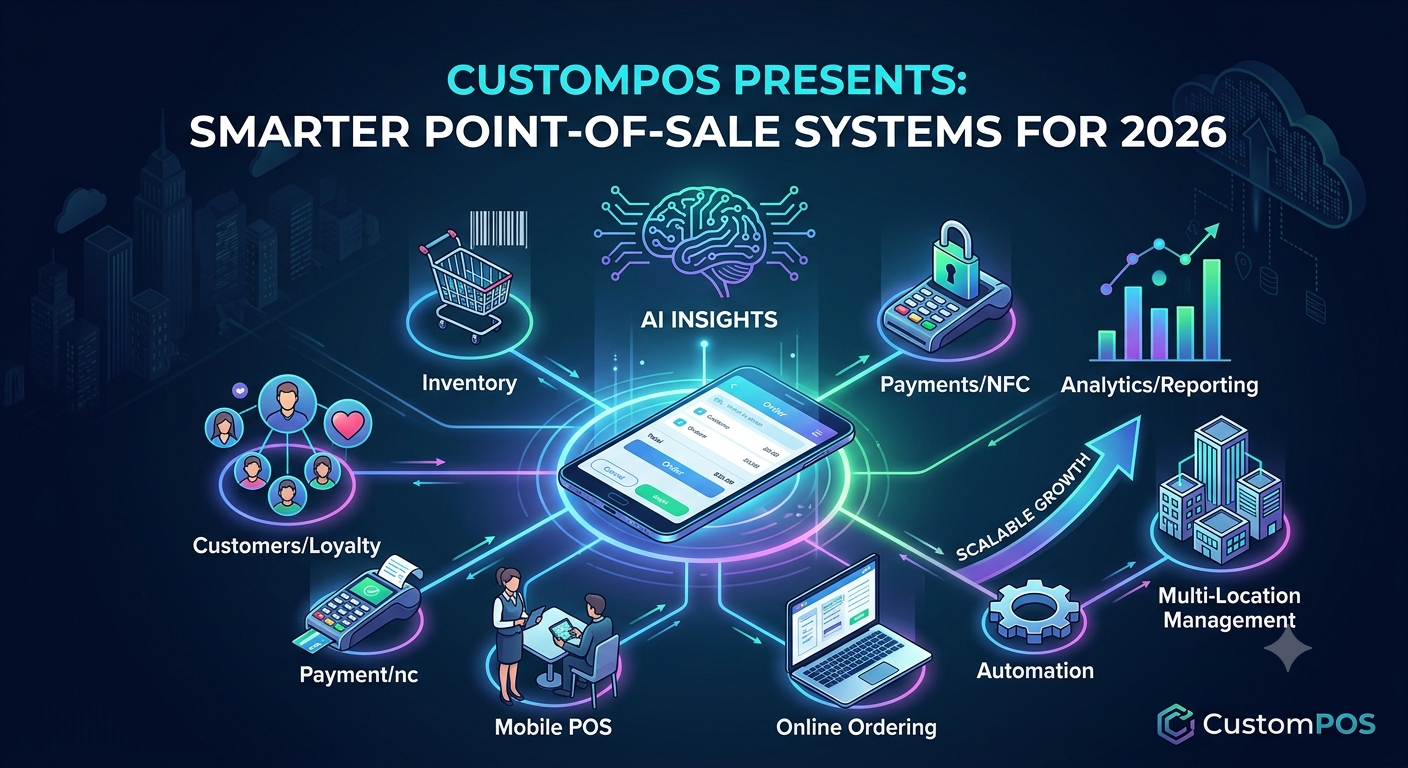
Point-of-sale software has evolved far beyond simply processing payments.
Modern restaurants, retailers, hotels, and growing businesses need POS systems that can manage transactions, inventory, customers, employees, payments, reporting, online orders, and multiple locations from a connected platform.
This is why more businesses are exploring custom POS software development.
Unlike generic POS products, a custom POS system can be designed around the specific workflows, products, customers, integrations, and operational requirements of a business.
In 2026, the next generation of POS systems is becoming even smarter with AI, cloud technology, real-time analytics, automation, mobile applications, payment integrations, and IoT.
For businesses looking for a custom POS development company, the right technology partner can help transform a traditional billing system into a complete business management platform.
What Is Custom POS Software Development?
Custom POS software development is the process of designing and building a point-of-sale system specifically for a business or industry.
Instead of adapting business operations to an existing POS product, companies can create software around their own requirements.
A custom POS solution can include:
- Billing and checkout
- Inventory management
- Employee management
- Customer management
- Online ordering
- Table management
- Payment processing
- Loyalty programs
- Discounts and promotions
- Multi-location management
- Sales reporting
- Business analytics
- Accounting integrations
- CRM integrations
- Mobile POS
- Cloud synchronization
This flexibility makes custom POS development particularly useful for businesses with specialized workflows.
Why Businesses Need Custom POS Systems in 2026
Traditional POS software was primarily designed to record sales.
Modern businesses need much more.
A restaurant owner may want the POS system to connect orders from the website, mobile app, QR code menu, delivery platform, kitchen display system, inventory system, and payment gateway.
A retail business may need POS software connected with warehouses, eCommerce platforms, loyalty programs, customer databases, and accounting systems.
A custom POS platform can bring these processes together.
One Connected Business Ecosystem
Customer → Order → POS → Payment → Inventory → Kitchen/Warehouse → Customer Data → Analytics
This connected approach gives businesses greater visibility and control.
1. Custom POS Software Can Match Your Business Workflow
Every business operates differently.
A restaurant may require:
- Table management
- Kitchen order tickets
- Menu customization
- Split billing
- Multiple payment methods
- Delivery orders
- Kitchen display integration
A retail business may need:
- Barcode scanning
- Product variants
- Stock management
- Purchase orders
- Customer loyalty
- Multi-store inventory
A generic POS platform may not support every requirement.
Custom POS application development allows businesses to build workflows around their actual operations.
2. AI Is Making POS Systems Smarter
Artificial intelligence is becoming an important part of modern POS technology.
AI-powered POS systems can help businesses analyze sales and operational data to identify patterns.
Potential applications include:
- Sales forecasting
- Product recommendations
- Customer personalization
- Demand prediction
- Inventory insights
- Fraud detection
- Automated reporting
- Staff scheduling assistance
- Business performance analysis
For example, an AI-enabled restaurant POS could analyze historical sales and identify which products are likely to experience higher demand during specific periods.
This can help businesses make better operational decisions.
3. Real-Time Inventory Management
Inventory problems can directly affect profitability.
Too much inventory can increase waste and storage costs.
Too little inventory can result in stockouts and lost sales.
A modern custom POS system can connect sales transactions directly with inventory data.
When a product is sold, inventory information can be updated automatically.
Businesses can use the system to monitor:
- Current stock
- Low-stock products
- Fast-moving products
- Slow-moving products
- Product costs
- Inventory valuation
- Purchase requirements
For restaurants, inventory management can also help monitor ingredients and reduce unnecessary food waste.
4. Cloud-Based POS Gives Businesses More Flexibility
Cloud technology has changed how POS systems are deployed and managed.
With a cloud-based POS system, authorized users can access business information from different locations and devices.
This can be particularly useful for businesses operating multiple stores, restaurants, or branches.
Managers can monitor:
- Sales
- Revenue
- Inventory
- Employees
- Orders
- Business performance
from a centralized platform.
Cloud architecture can also make software updates and centralized management easier.
5. Multi-Location POS Management
Managing multiple locations can become complicated when each location uses disconnected systems.
A custom POS platform can provide centralized management while allowing individual locations to maintain their own operational settings.
For example:
Head Office → Location A + Location B + Location C + Location D
Management can monitor overall performance while each location manages its daily transactions.
This can support:
- Centralized product management
- Location-specific pricing
- Inventory transfers
- Sales reporting
- Employee management
- Customer data
- Centralized analytics
6. POS and Payment Integration
Customers expect convenient payment options.
A modern POS system may need to support:
- Credit and debit cards
- Contactless payments
- Digital wallets
- QR payments
- Online payments
- Integrated payment terminals
Custom POS development allows businesses to integrate payment technologies based on their market and operational requirements.
For businesses handling sensitive payment information, security and compliance should be considered from the beginning of the development process.
7. Mobile POS Is Changing Customer Service
POS systems are no longer restricted to traditional checkout counters.
Mobile POS applications allow employees to process transactions using tablets or mobile devices.
Restaurants can use mobile POS solutions for tableside ordering.
Retailers can use mobile devices to check inventory and complete transactions away from the traditional checkout area.
Mobile POS can help create faster and more flexible customer experiences.
8. POS Integration With Online Ordering
Customers increasingly interact with businesses through multiple channels.
A restaurant may receive orders through:
- Website
- Mobile app
- QR menu
- Delivery platform
- In-store counter
- Phone
A connected POS platform can bring these orders into a centralized system.
This reduces the need for employees to manually enter information from multiple systems.
It can also help businesses maintain more accurate order and sales records.
9. Customer Data and Loyalty Programs
A modern POS system can become an important source of customer information.
Businesses can use POS data to understand:
- Purchase history
- Frequently purchased products
- Customer preferences
- Visit frequency
- Average order value
- Loyalty activity
Businesses can then use this information to create more relevant loyalty and marketing programs.
For example, a restaurant could provide personalized offers based on customer purchase behavior.
10. Business Analytics and Reporting
A POS system generates valuable business data every day.
Instead of using POS software only for transactions, businesses can use this data for decision-making.
Useful dashboards can show:
- Daily sales
- Weekly sales
- Monthly revenue
- Best-selling products
- Product performance
- Employee performance
- Location performance
- Payment trends
- Customer activity
AI-powered analytics can take this further by identifying patterns and potential opportunities.
Custom POS vs. Off-the-Shelf POS
Both options have advantages.
| Custom POS Software | Off-the-Shelf POS |
|---|---|
| Designed for specific business needs | Designed for general requirements |
| Highly customizable | Limited customization |
| Flexible integrations | Depends on available integrations |
| Can scale around business requirements | Scaling depends on provider |
| Can support specialized workflows | Uses predefined workflows |
| Higher initial development investment | Usually faster to deploy |
For a small business with straightforward requirements, an off-the-shelf solution may be sufficient.
For businesses with complex workflows, multiple locations, specialized integrations, or long-term technology goals, custom POS development can provide greater flexibility.
How Much Does Custom POS Software Development Cost?
The cost of developing a custom POS system depends on the complexity of the project.
Factors that can influence development cost include:
- Number of POS terminals
- Web or mobile requirements
- Number of locations
- Inventory functionality
- Payment integrations
- Hardware integrations
- Customer loyalty features
- Online ordering
- Accounting integrations
- AI functionality
- Reporting and analytics
- Cloud infrastructure
- Security requirements
- Third-party integrations
A basic POS application may require significantly less development effort than a complete enterprise platform connecting multiple locations, payment systems, inventory, online ordering, and AI analytics.
The best approach is to define the business requirements first and then create a development roadmap.
How to Choose a Custom POS Development Company
Choosing a development partner is an important decision.
Look for a company with experience in:
POS Development
The team should understand the complexities of transaction processing, inventory, orders, payments, and reporting.
Mobile and Web Development
Modern POS ecosystems often require both web dashboards and mobile applications.
Payment Integration
The development partner should understand secure payment integrations and the relevant compliance requirements.
Cloud Development
Cloud infrastructure can support centralized management, synchronization, backups, and scalability.
API Integration
POS systems often need to communicate with accounting, CRM, eCommerce, delivery, payment, and inventory platforms.
Security
Customer and transaction data should be protected through appropriate authentication, authorization, encryption, secure APIs, and monitoring.
Why CustomPOS for Modern POS Solutions?
CustomPOS focuses on building flexible point-of-sale solutions for businesses that need more than basic billing software.
A modern POS platform can bring together:
Sales + Inventory + Customers + Payments + Analytics + Automation
The goal is to help businesses create a connected technology environment rather than operate multiple disconnected systems.
For restaurants, retail businesses, hospitality companies, and growing enterprises, a customized POS platform can be designed around the specific way the business operates.
The Future of POS Software Development
The POS industry is moving toward intelligent and connected platforms.
The future of POS will increasingly combine:
AI + Cloud + Mobile + Payments + IoT + Analytics + Automation
AI can provide intelligent insights.
Cloud technology can connect locations.
Mobile applications can improve flexibility.
IoT can connect hardware and devices.
Analytics can turn transaction data into business intelligence.
Automation can reduce repetitive tasks.
Together, these technologies can transform POS software from a simple billing tool into a complete business platform.
Final Thoughts
A modern POS system should do more than process transactions.
It should help businesses understand customers, manage inventory, improve operations, integrate payment systems, analyze sales, and make better decisions.
For businesses with specialized requirements, custom POS software development can provide the flexibility needed to build a solution around their unique workflows.
Whether you operate a restaurant, retail store, hotel, franchise, or multi-location business, investing in the right POS technology can create a stronger foundation for growth.
If your business needs a POS platform designed around its specific requirements, CustomPOS can help turn your POS concept into a scalable digital solution.
Comments