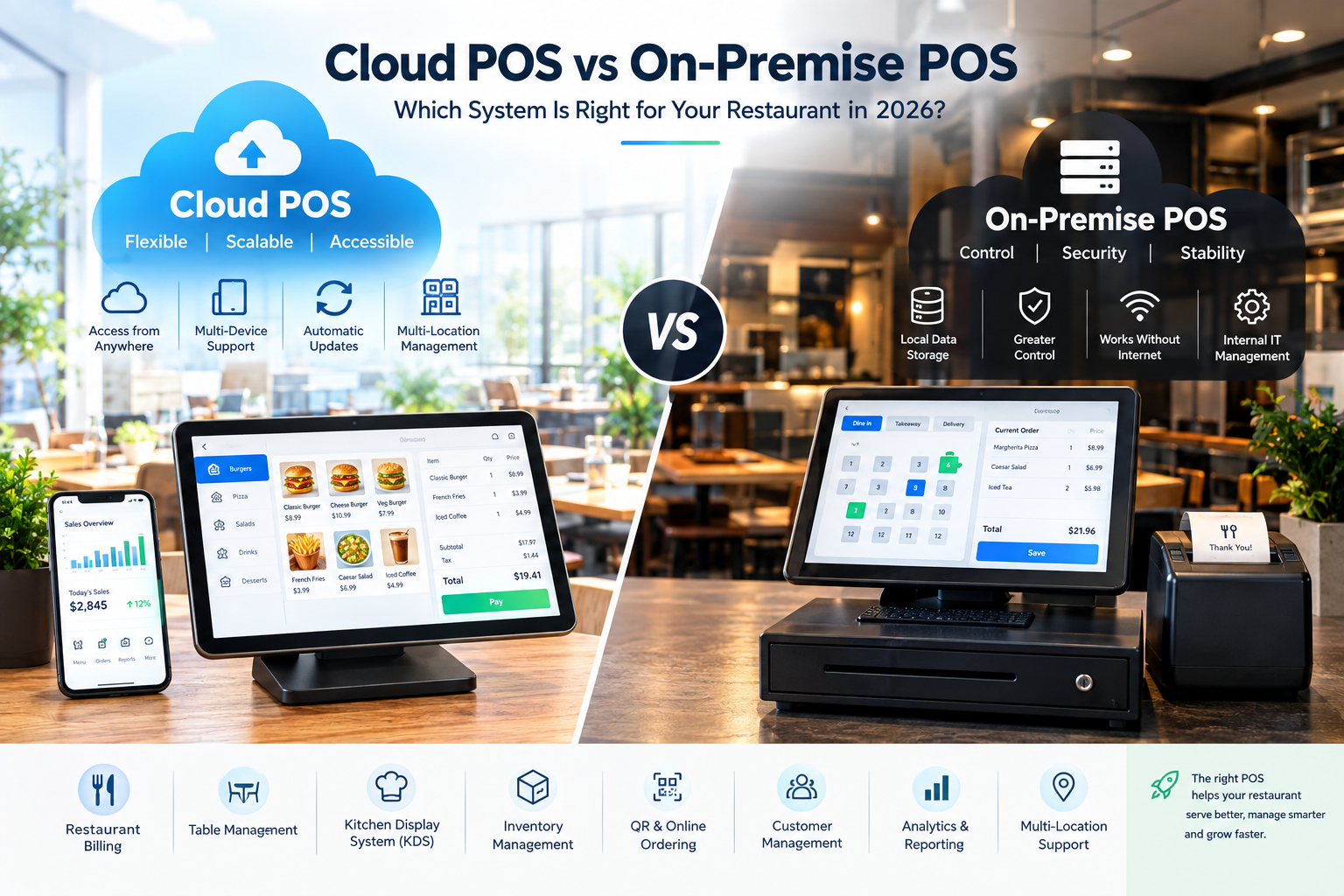
Running a modern restaurant involves much more than taking orders and printing receipts. Restaurants, cafés, hotels, QSRs, cloud kitchens, and multi-location food businesses need technology that connects billing, inventory, kitchen operations, payments, customer management, online orders, and business analytics.
That is why choosing the right POS software for restaurants has become an important technology decision.
One of the biggest questions businesses face is whether to choose a cloud-based POS system or an on-premise POS system.
Both models have their own advantages and limitations. The right choice depends on the restaurant’s size, operating model, connectivity, security requirements, budget, and growth plans.
What Is a Cloud POS System?
A cloud POS system stores and processes business data through cloud-based infrastructure rather than relying entirely on a local server at the restaurant.
Restaurant owners and managers can typically access dashboards and business information through connected devices, depending on the POS provider’s architecture and features.
A cloud POS can connect different parts of a restaurant operation, including:
- Billing and invoicing
- Order management
- Inventory management
- Kitchen Display Systems (KDS)
- Table management
- Online ordering
- Customer management
- Payment integrations
- Sales reporting
- Multi-location management
This makes cloud POS software particularly useful for businesses that want centralized management.
What Is an On-Premise POS System?
An on-premise POS system is primarily installed and operated on hardware or servers controlled by the business at its physical location.
Instead of relying heavily on remote cloud infrastructure, the restaurant maintains its own local POS environment.
This model can provide businesses with greater direct control over their infrastructure, b
Comments