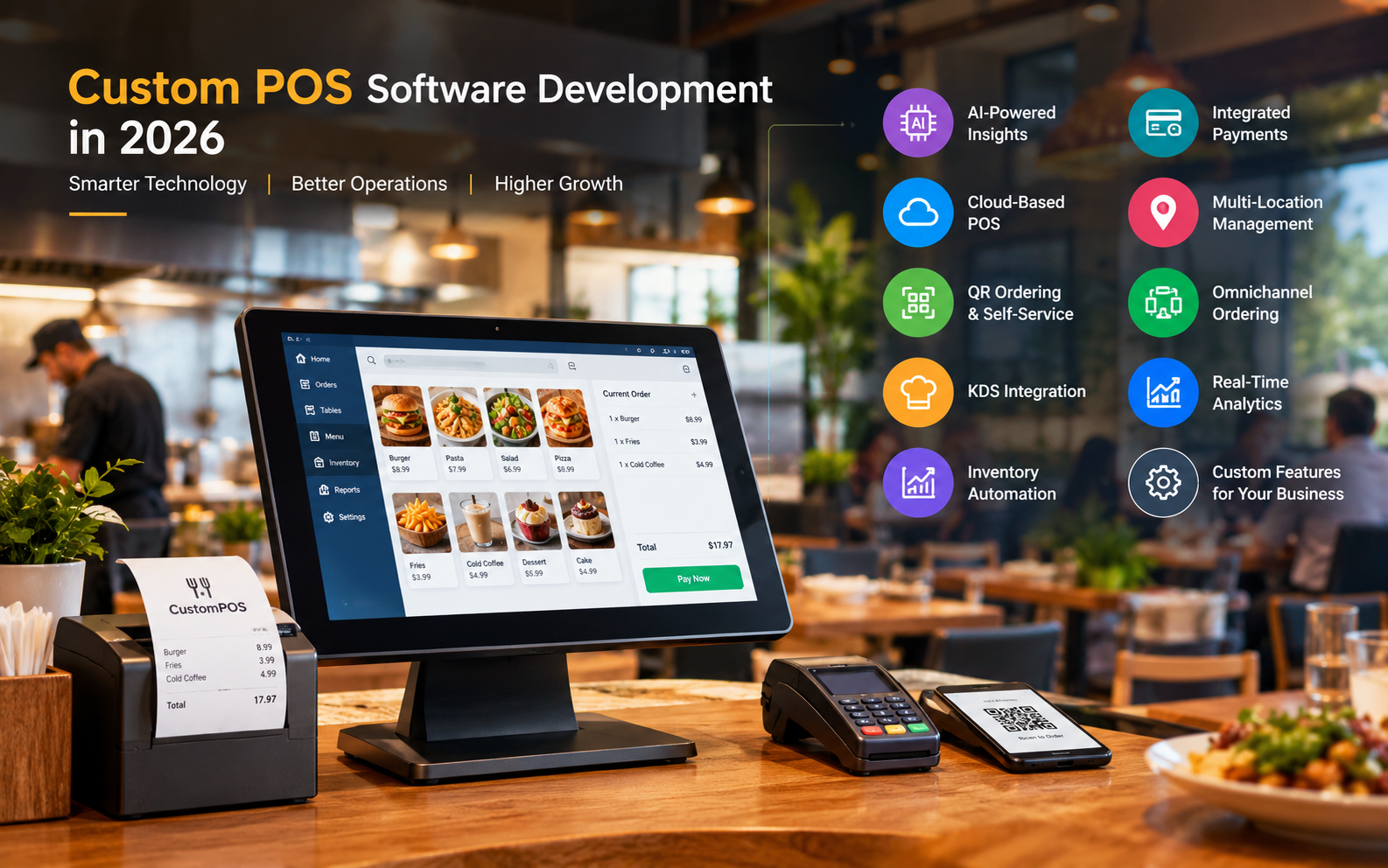
The restaurant industry is moving beyond traditional billing software. In 2026, restaurants, cafés, QSRs, hotels, cloud kitchens, and retail businesses are looking for custom POS software development that connects sales, payments, inventory, kitchen operations, customer data, and business analytics in one intelligent platform.
Modern POS systems are becoming operational hubs rather than simple cash registers. AI, cloud technology, QR ordering, self-service, real-time analytics, digital payments, and automated inventory management are shaping the next generation of point-of-sale solutions.
For businesses planning to build or upgrade a POS platform, understanding these trends can help create a system that is scalable, flexible, and ready for future growth.
What Is Custom POS Software Development?
Custom POS software development involves building a point-of-sale system specifically around the operational requirements of a business.
Instead of adapting business processes to an off-the-shelf POS, a custom solution can be designed around specific workflows such as:
- Restaurant and café billing
- Table and floor management
- Kitchen Order Tickets (KOT)
- Kitchen Display Systems (KDS)
- QR code ordering
- Online ordering
- Inventory management
- Supplier management
- Employee management
- Loyalty programs
- Customer relationship management
- Digital payments
- Multi-location management
- Sales and financial reporting
This approach gives businesses greater control over functionality, integrations, user experience, and future upgrades.
Why Custom POS Development Is Trending in 2026
Restaurant technology is increasingly becoming interconnected. Industry research shows that POS modernization and stronger system integration are major priorities, while AI-powered modules are also gaining attention.
A modern POS can connect:
Customer → Ordering → POS → Payment → Kitchen → Inventory → Analytics
This connected architecture reduces manual work and gives restaurant owners a clearer view of business performance.
Top Custom POS Development Trends in 2026
1. AI-Powered POS Systems
Artificial intelligence is becoming one of the biggest trends in restaurant POS development.
AI can analyze sales, inventory, customer behavior, and operational data to provide useful recommendations.
A custom AI-powered POS can help with:
- Sales forecasting
- Inventory forecasting
- Menu performance analysis
- Customer segmentation
- Personalized promotions
- Labor forecasting
- Food-waste monitoring
- Business performance insights
Restaurant operators are already using AI tools to analyze sales, menu, inventory, marketing, and operational data.
The goal is not simply to add an AI chatbot to a POS. The real opportunity is using AI to turn restaurant data into actionable business decisions.
2. Cloud-Based POS Development
Cloud POS is becoming increasingly important for growing restaurant businesses.
A cloud-based POS allows authorized users to access business information from different locations while keeping operational data synchronized.
Important capabilities include:
- Real-time sales monitoring
- Centralized reporting
- Remote menu management
- Multi-location management
- Cloud inventory tracking
- Automated backups
- Role-based access
- Real-time synchronization
For restaurant chains, cloud architecture can make it easier to manage multiple outlets from a centralized platform.
3. QR Code Ordering
QR ordering has evolved from a temporary contactless solution into a regular digital ordering channel.
Customers can scan a QR code, browse the menu, customize items, place an order, and make a payment from their smartphones.
A custom POS can connect QR ordering directly with:
QR Menu → POS → KDS → Payment → Inventory
This reduces manual order entry and can improve order accuracy.
4. Kitchen Display System Integration
KDS integration is another important part of modern POS development.
Instead of relying completely on printed kitchen tickets, orders can automatically appear on digital kitchen screens.
A custom KDS can organize orders by:
- Kitchen station
- Order type
- Priority
- Preparation time
- Table number
- Delivery or takeaway status
This creates a more connected workflow between front-of-house and kitchen operations.
5. Predictive Inventory Management
Inventory management is one of the biggest challenges for restaurants.
A modern POS can combine historical sales data with current inventory information to help businesses estimate future requirements.
Predictive inventory features can help identify:
- Fast-moving products
- Slow-moving products
- Low-stock items
- Potential stockouts
- Overstocking
- Food-waste patterns
- Purchasing requirements
AI and predictive analytics are increasingly being applied to inventory and sales forecasting in restaurant operations.
6. Integrated Digital Payments
Customers expect fast and flexible payment options.
Custom POS development can integrate:
- Credit and debit cards
- Contactless payments
- Mobile wallets
- QR payments
- Digital wallets
- Online payments
- Split payments
- Partial payments
Payment integration should also be designed with security, compliance, transaction reliability, and reconciliation in mind.
7. Self-Service Kiosks
Self-service kiosks are becoming an important part of restaurant technology, particularly for QSRs and high-volume locations.
A kiosk can allow customers to:
- Browse the menu
- Customize their order
- Add extras
- Pay digitally
- Receive an order number
The kiosk should communicate directly with the POS and kitchen system so that orders do not need to be manually entered again.
8. Voice Ordering and AI Assistants
Voice technology is another emerging opportunity for restaurant POS development.
AI-powered voice ordering can potentially handle common customer requests, capture orders, answer menu questions, and send order information directly into restaurant systems.
The broader trend is toward connecting customer-facing AI with operational systems rather than treating voice technology as a standalone tool.
9. Omnichannel Ordering
Modern restaurants may receive orders from several channels:
- In-store POS
- Restaurant website
- Mobile app
- QR menu
- Kiosk
- Delivery platforms
- Social channels
A custom POS should bring these orders into a unified system.
This helps reduce duplicate data entry and gives restaurant managers a centralized view of sales.
10. Real-Time Analytics and Dashboards
Restaurant owners need more than daily sales totals.
Modern POS dashboards can provide real-time insights into:
- Revenue
- Average order value
- Best-selling products
- Sales by location
- Payment methods
- Inventory
- Employee performance
- Customer activity
- Discounts
- Voids and refunds
- Profitability indicators
Real-time reporting helps managers identify operational issues faster and make data-driven decisions.
Essential Features of Custom POS Software
When planning a custom POS development project, businesses should consider the following core modules:
| Module | Key Function |
|---|---|
| Billing | Fast and flexible checkout |
| Inventory | Stock and ingredient tracking |
| KOT | Digital kitchen order management |
| KDS | Kitchen workflow management |
| QR Ordering | Smartphone-based ordering |
| Payments | Integrated digital payments |
| CRM | Customer information and engagement |
| Loyalty | Rewards and retention |
| Analytics | Real-time business insights |
| Employee Management | Roles, permissions and performance |
| Multi-Location | Centralized outlet management |
| Online Ordering | Website and app orders |
| AI | Forecasting and intelligent recommendations |
Custom POS Development for Different Businesses
Custom POS software can be developed for different business models, including:
Restaurants
Restaurant POS systems can combine table management, billing, KOT, KDS, inventory, payments, and customer management.
Cafés
Café POS solutions can focus on quick billing, menu customization, loyalty programs, inventory, and digital ordering.
QSRs
Quick-service restaurants need high-speed ordering, kiosks, kitchen automation, digital payments, and order tracking.
Hotels
Hotel POS systems can integrate restaurant billing with room management, guest accounts, multiple outlets, and centralized reporting.
Cloud Kitchens
Cloud kitchens can benefit from online ordering, multi-brand management, delivery integrations, kitchen workflows, and inventory automation.
Retail Businesses
Retail POS development can include barcode scanning, product management, inventory, customer accounts, discounts, payments, and reporting.
How to Build a Future-Ready Custom POS
A successful POS development project should not focus only on today’s requirements.
The architecture should be designed for future integrations and expansion.
A typical development process includes:
1. Business Analysis
Understand the restaurant’s workflow, users, locations, and operational challenges.
2. Feature Planning
Define the required POS, inventory, payment, kitchen, CRM, and reporting modules.
3. UI/UX Design
Create simple interfaces for cashiers, servers, managers, kitchen staff, and administrators.
4. Technology Architecture
Design a scalable architecture capable of handling increasing users, transactions, and locations.
5. Development & API Integration
Build the POS and integrate payment gateways, delivery platforms, accounting tools, KDS, CRM, and other systems.
6. Testing
Test billing, payments, synchronization, inventory, security, offline functionality, and high-volume transactions.
7. Deployment
Launch the platform and monitor performance.
8. Continuous Improvement
Use analytics and customer feedback to introduce new features and AI-powered capabilities.
Why Choose Custom POS Software Development?
A custom POS platform can provide several advantages over generic software:
- Complete control over features
- Flexible integrations
- Custom workflows
- Better scalability
- Improved automation
- Personalized user experience
- Centralized business data
- Support for multiple locations
- Easier future customization
Most importantly, businesses can build the POS around their actual operational requirements rather than changing their processes to fit generic software.
The Future of POS Development
The future of POS is not simply about faster billing.
The next generation of POS platforms will increasingly connect AI, payments, ordering, inventory, kitchen operations, customer engagement, and analytics into one ecosystem.
The strongest platforms will be able to collect operational data, analyze it, identify patterns, and help restaurant owners make faster decisions.
As restaurant businesses become more digital, custom POS software development can provide the flexibility needed to create a scalable technology ecosystem.
Build a Custom POS Solution With CustomPOS
Whether you are developing a POS platform for a restaurant, café, QSR, hotel, cloud kitchen, or retail business, a well-designed custom solution can help connect your entire operation.
From AI-powered analytics and cloud POS to QR ordering, KDS, inventory automation, digital payments, and multi-location management, the right architecture can turn a traditional POS into a complete business management platform.
Looking to build a custom POS software solution? CustomPOS can help you plan, develop, integrate, and scale a modern POS platform designed around your business requirements.
Target SEO Keywords
- custom POS software development
- custom POS development
- POS software development
- restaurant POS software development
- custom restaurant POS software
- POS system development
- AI-powered POS system
- cloud POS development
- restaurant POS development
- POS software development company
- custom restaurant management software
- KDS integration
- QR ordering system
- restaurant inventory management software
- multi-location POS software
- AI POS software
- restaurant technology trends 2026
- POS development trends 2026
Comments